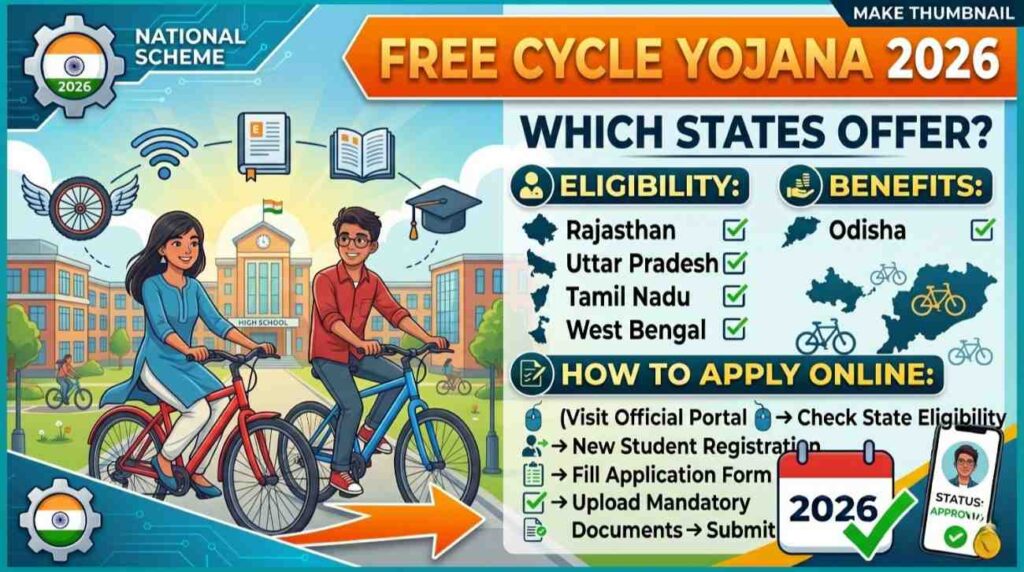
- Free Cycle Yojana 2026: Which States Give Free Cycles to Students and How to Apply
- Key Takeaways
- Introduction
- What Is Free Cycle Yojana 2026?
- State-Wise Free Cycle Yojana 2026 — Complete Details
- State-Wise Free Cycle Scheme — Quick Comparison Table 2026
- Key Features and Benefits
- Eligibility Criteria — Combined Overview
- How to Apply — Step-by-Step Process
- Impact of Free Cycle Yojana — Data and Ground Reality
- Free Cycle Yojana vs Other School Support Schemes — Comparison
- Frequently Asked Questions (FAQ)
- Conclusion
Free Cycle Yojana 2026: Which States Give Free Cycles to Students and How to Apply
Meta Description: Complete guide to Free Cycle Yojana 2026 — which state governments provide free cycles to students, eligibility criteria, required documents and step-by-step application process. Read the full guide now.
Key Takeaways
- Free Cycle Yojana 2026 is offered by multiple state governments to help students — especially girls and SC/ST students — commute to school regularly.
- Bihar, Uttar Pradesh, Rajasthan, Madhya Pradesh, Jharkhand, and several other states have active free cycle distribution schemes.
- Most schemes target students entering Class 6 or Class 9 in government schools who live more than 2 km from school.
- Applications are processed through schools — students do not need to apply individually online in most states.
- Free cycles significantly reduce school dropout rates — especially among rural girl students who previously could not commute safely.
Introduction
In hundreds of thousands of villages across India a simple question determines whether a child goes to school — “How will she get there?” When the nearest government school is 3, 4, or 5 kilometers away and there is no bus, no auto, and no money for transport — millions of children — especially girls — simply stop attending. Free Cycle Yojana 2026 is one of the most practical and impactful answers India’s state governments have found to this everyday barrier. By providing free bicycles to eligible students — particularly girls and children from SC, ST, and economically weaker families — these schemes have transformed school attendance and dramatically reduced dropout rates in rural India. In 2026 states like Bihar, Uttar Pradesh, Rajasthan, Madhya Pradesh, Jharkhand, Odisha, and many others are actively distributing free cycles under various scheme names — each designed to keep one more child in school one more year. This complete guide covers every active Free Cycle Scheme in India — state by state — with eligibility conditions, required documents, and the exact application process for each.
What Is Free Cycle Yojana 2026?
Free Cycle Yojana 2026 is the collective term for multiple state government schemes that distribute free bicycles to students — primarily in Classes 6 to 9 — studying in government schools across India. Like Free Laptop schemes, there is no single national Free Cycle Yojana — each state designs and funds its own program based on local needs, budget availability, and educational priorities.
The fundamental objective across all Free Cycle schemes is the same — remove the distance barrier that prevents children from attending school regularly. Research consistently shows that when a school is more than 2 kilometers from a child’s home the risk of dropout increases dramatically — especially for girls whose families are concerned about safety during long walks and for children from poor families who cannot afford daily transport costs.
Free Cycle Yojana programs address this through three measurable outcomes:
- Increased Enrollment — More children enroll in Class 6 and Class 9 when they know a free cycle will be provided
- Improved Attendance — Daily school attendance improves when commute time and physical effort are reduced
- Reduced Dropout — Particularly among girl students — dropout rates fall significantly when safe, independent commute becomes possible
Most state Free Cycle schemes also have a powerful secondary benefit — giving girl students independence and confidence by enabling them to commute without depending on male family members — a transformational social impact in conservative rural communities.
State-Wise Free Cycle Yojana 2026 — Complete Details
1. Bihar Mukhyamantri Cycle Yojana 2026
Bihar’s Free Cycle scheme is one of the oldest and most impactful in India — started in 2007 and credited with dramatically improving girl student enrollment across the state.
| Detail | Information |
|---|---|
| State | Bihar |
| Scheme Name | Mukhyamantri Cycle Yojana |
| Launched By | Bihar State Government |
| Target Students | Class 9 students in government schools |
| Gender | Both boys and girls — girls given priority |
| Distance Condition | Students living more than 2 km from school |
| Amount | ₹3,000 cash transferred to student’s bank account for cycle purchase |
| Payment Mode | Direct Bank Transfer — student’s Aadhaar-linked account |
| Income Condition | No strict income limit — all government school Class 9 students |
| Application Process | Through school — headmaster submits list to district education office |
| Official Portal | state.bihar.gov.in — Education Department |
2. Uttar Pradesh Free Cycle Yojana 2026
Uttar Pradesh provides free cycles to students in Classes 6 and 9 in government schools — with special focus on SC, ST, and girls from economically weaker families.
| Detail | Information |
|---|---|
| State | Uttar Pradesh |
| Scheme Name | UP Muft Cycle Vitran Yojana |
| Target Students | Class 6 and Class 9 government school students |
| Gender | Girls given priority — boys from SC/ST also eligible |
| Distance Condition | Minimum 2 km distance from home to school |
| Category Priority | SC / ST / OBC students preferred |
| Income Limit | Family income below ₹2 lakh per year |
| Application Process | Through school headmaster to Block Education Officer |
| Official Portal | up.gov.in — Basic Education Department |
3. Rajasthan Free Cycle Scheme 2026
Rajasthan provides free cycles specifically to girl students in Classes 6 and 9 under its girl child education promotion initiatives.
| Detail | Information |
|---|---|
| State | Rajasthan |
| Scheme Name | Rajasthan Muft Cycle Vitran Yojana |
| Target Students | Girl students in Class 6 and Class 9 |
| Gender | Girls only — boys not covered |
| Distance Condition | Living more than 2 km from school |
| School Type | Government and government-aided schools only |
| Income Condition | Family below poverty line preferred |
| Application Process | School submits consolidated list to DEO |
| Official Portal | rajasthan.gov.in — School Education Department |
4. Madhya Pradesh Free Cycle Yojana 2026
Madhya Pradesh runs one of India’s largest free cycle programs — targeting both boys and girls from SC and ST communities in Classes 6 and 9.
| Detail | Information |
|---|---|
| State | Madhya Pradesh |
| Scheme Name | MP Mukhyamantri Cycle Yojana |
| Target Students | Class 6 and Class 9 SC/ST students |
| Gender | Both boys and girls |
| Distance Condition | More than 2 km from school |
| Category | SC and ST students exclusively |
| Income Condition | BPL families given priority |
| Application Process | Through school headmaster and district tribal welfare office |
| Official Portal | shikshaportal.mp.gov.in |
5. Jharkhand Free Cycle Scheme 2026
Jharkhand provides free cycles to girl students in government schools — with special focus on tribal area students in scheduled districts.
| Detail | Information |
|---|---|
| State | Jharkhand |
| Scheme Name | Jharkhand Mukhyamantri Balika Cycle Yojana |
| Target Students | Class 8 and Class 9 girl students |
| Gender | Girls only |
| Category Focus | ST girls in scheduled tribal districts priority |
| Distance Condition | More than 2 km from school |
| Income Condition | BPL family or ST community |
| Application Process | Through school to District Education Office |
| Official Portal | jharkhand.gov.in — Education Department |
6. Odisha Free Cycle Scheme 2026
Odisha provides free cycles under its Medhavi Scholarship and Cycle scheme to meritorious girl students in Classes 8 and 9.
| Detail | Information |
|---|---|
| State | Odisha |
| Scheme Name | Odisha Cycle Distribution Scheme |
| Target Students | Class 8 and Class 9 girl students |
| Gender | Girls priority — ST boys also covered |
| Merit Condition | Minimum 50% marks in previous class |
| Distance Condition | More than 2 km from school |
| Application Process | Through school headmaster and BEO |
| Official Portal | schoolandmass.in |
7. Chhattisgarh Free Cycle Yojana 2026
Chhattisgarh provides free cycles to girl students in Classes 6 and 9 — with priority for SC, ST, and OBC communities in tribal districts.
| Detail | Information |
|---|---|
| State | Chhattisgarh |
| Target Students | Class 6 and Class 9 girl students |
| Category Focus | SC / ST / OBC girl students priority |
| Distance Condition | More than 2 km from school |
| Income Condition | Family income below ₹1 lakh per year |
| Application Process | Through school and district education office |
| Official Portal | cgschool.in |
8. West Bengal Free Bicycle Scheme 2026
West Bengal distributes free bicycles to girl students in Class 9 under its Sabooj Sathi scheme — one of India’s largest free cycle programs covering over 1 crore students.
| Detail | Information |
|---|---|
| State | West Bengal |
| Scheme Name | Sabooj Sathi — Green Companion |
| Target Students | Class 9 to Class 12 students |
| Gender | Both boys and girls in government schools |
| Distance Condition | No strict distance condition — all eligible |
| Income Condition | No income limit — all government school students |
| Coverage | 1 crore+ students — largest free cycle program in India |
| Official Portal | wbsaboojsathi.gov.in |
State-Wise Free Cycle Scheme — Quick Comparison Table 2026
| State | Scheme Name | Target Class | Gender | Category | Distance | Portal |
|---|---|---|---|---|---|---|
| Bihar | Mukhyamantri Cycle Yojana | Class 9 | Both — girls priority | All govt. students | 2+ km | state.bihar.gov.in |
| Uttar Pradesh | UP Muft Cycle Vitran | Class 6 and 9 | Girls priority — SC/ST boys | SC/ST/OBC priority | 2+ km | up.gov.in |
| Rajasthan | Muft Cycle Vitran | Class 6 and 9 | Girls only | BPL preferred | 2+ km | rajasthan.gov.in |
| Madhya Pradesh | Mukhyamantri Cycle Yojana | Class 6 and 9 | Both | SC/ST only | 2+ km | shikshaportal.mp.gov.in |
| Jharkhand | Balika Cycle Yojana | Class 8 and 9 | Girls only | ST priority | 2+ km | jharkhand.gov.in |
| Odisha | Cycle Distribution Scheme | Class 8 and 9 | Girls priority | All govt. students | 2+ km | schoolandmass.in |
| Chhattisgarh | Free Cycle Yojana | Class 6 and 9 | Girls priority | SC/ST/OBC | 2+ km | cgschool.in |
| West Bengal | Sabooj Sathi | Class 9 to 12 | Both | All govt. students | No condition | wbsaboojsathi.gov.in |
Details are approximate and based on 2026 available scheme information. Always verify exact eligibility conditions in your state’s official current notification.
Key Features and Benefits
Free Cycle Yojana programs across India deliver benefits that go far beyond simple transport convenience:
- Eliminates Distance Barrier — For students living 2 to 5 kilometers from school a free cycle reduces commute time from over an hour of walking to 15 to 20 minutes — making daily attendance genuinely practical rather than physically exhausting.
- Dramatically Reduces Girl Child Dropout — Research across Bihar and West Bengal has documented that free cycle programs reduced girl student dropout rates by 30% to 40% — one of the most impactful education interventions ever implemented in India.
- Empowers Girl Students Independently — A cycle gives girl students the ability to commute independently — without depending on male family members or walking through unsafe routes — improving both safety and personal confidence.
- Reduces Family Financial Burden — Poor families that previously spent ₹500 to ₹1,500 per month on children’s transport to school save significantly — that money is redirected to nutrition, books, and household needs.
- Improves Punctuality and Academic Performance — Students who are not physically exhausted from walking to school arrive on time, concentrate better in class, and show measurably improved academic performance compared to walkers.
- Covers Physical Education — Students with free cycles participate more in school sports, cultural events, and extracurricular activities — because transportation is no longer a barrier to staying after school hours.
- Environmental Benefit — Free cycles promote non-motorized, eco-friendly transport among India’s youth — building healthy habits and environmental consciousness from school age.
- Social Equity — Free cycles visually eliminate the economic divide between students who arrive at school on cycles and those who walk — every student arrives by cycle when the scheme covers the entire eligible class — building a more equal classroom environment.
Eligibility Criteria — Combined Overview
Master Eligibility Table 2026
| Criterion | General Condition Across States |
|---|---|
| Class Level | Class 6 to Class 9 — varies by state |
| School Type | Government or government-aided schools only |
| Distance from School | Minimum 2 km from student’s home — most states |
| Gender | Girls in most states — some states cover boys too |
| Community | SC/ST/OBC students in many states — some states cover all |
| Income | BPL or below ₹1 lakh to ₹2 lakh per year — varies by state |
| Residence | Must be permanent resident of the respective state |
| Previous Cycle | Must not have received a free cycle under any scheme before |
| Enrollment | Must be currently enrolled in the eligible class |
| Attendance | Some states require minimum 75% attendance record |
Required Documents for Free Cycle Application
- Aadhaar card of student — for identity verification
- School enrollment certificate — confirming class and school name
- Residential proof — showing distance from school — Aadhaar address or ration card
- Caste certificate — SC / ST / OBC — issued by competent authority
- BPL or income certificate — for income-based eligibility states
- Bank account passbook — in student’s name and Aadhaar-linked — for cash transfer states like Bihar
- Parent or guardian Aadhaar card
- Recent passport-size photograph — white background clear face
- Previous class marksheet — for merit-based eligibility states
How to Apply — Step-by-Step Process
Unlike most government schemes that require individual online applications — Free Cycle Yojana applications in most states are processed through the school — making it important to coordinate with your school rather than applying individually. Follow these eight steps:
- Contact your school headmaster immediately — The most important first step is to visit your school’s headmaster or class teacher and inform them that you are eligible for the Free Cycle Yojana. In most states the school prepares a consolidated list of eligible students and submits it to the Block Education Officer — individual students do not submit separate applications.
- Confirm your state’s current Free Cycle Scheme notification — Ask your school headmaster for the current year’s district education department notification about Free Cycle Yojana. This document specifies the exact eligibility conditions — class, distance, category, income limit — for your state in 2026. Different districts sometimes have different distribution timelines.
- Verify your distance eligibility — Most states require students to live more than 2 km from school. Measure the actual road distance from your home to school — not straight-line distance. If your address on Aadhaar card clearly shows a different village or ward from the school’s village — your distance eligibility is usually automatically verified.
- Prepare all required documents — Gather your Aadhaar card, school enrollment certificate, caste certificate, income certificate or BPL card, residential proof, and bank account passbook. Keep both original documents and clear photocopies of each — schools typically need attested photocopies for submission to the BEO office.
- Submit documents to school headmaster — Hand over your complete document set to the school headmaster before the school’s internal deadline — which is typically 2 to 4 weeks before the district submission deadline. Schools that receive incomplete document sets from students often drop those students from the eligible list — so ensure your documents are complete and submitted on time.
- School submits consolidated list to Block Education Officer — Your school headmaster prepares the complete list of eligible students with verified documents and submits it to the Block Education Office. The BEO consolidates lists from all schools in the block and forwards to the District Education Officer for final approval and procurement processing.
- Track distribution through school notices — After approval the state government procures cycles in bulk through tender process and schedules distribution events. Your school will display notice board announcements and send communication to eligible students about the distribution date, venue, and what to bring. Stay in regular contact with your school regarding distribution updates.
- Collect your free cycle at distribution event — or receive DBT — Attend the distribution event on the announced date with your original Aadhaar card and school ID. In states like Bihar where ₹3,000 cash is transferred instead of a physical cycle — check your Aadhaar-linked bank account after the distribution announcement date for the DBT credit and purchase your cycle from any local shop.
Pro Tip: In states where the school submits the eligible student list — your name being on that list is everything. Proactively visit your headmaster at the beginning of the academic year — ideally in the first month of Class 9 or Class 6 as applicable — and specifically ask whether the Free Cycle Yojana list is being prepared. Many students miss out simply because they assumed the school would automatically include them — without ever confirming with the headmaster. Being proactive and submitting your documents early ensures your name is on the first list submitted — not added as an afterthought after the deadline has passed.
Impact of Free Cycle Yojana — Data and Ground Reality
Measured Impact Across States
| State | Scheme | Key Impact Measured |
|---|---|---|
| Bihar | Mukhyamantri Cycle Yojana | Girl enrollment in secondary school increased by 30% in first 3 years |
| West Bengal | Sabooj Sathi | Over 1 crore cycles distributed — attendance improvement documented in 82% of beneficiary schools |
| Rajasthan | Muft Cycle Vitran | Girl dropout rate in Class 6 to 9 reduced by 25% in scheme-covered districts |
| Madhya Pradesh | Mukhyamantri Cycle Yojana | ST girl enrollment in Class 6 increased by 40% in tribal districts within 2 years |
| Jharkhand | Balika Cycle Yojana | Tribal girl attendance improved by 35% in Santhal Pargana division |
Impact figures are based on state government reports, independent research studies, and DISE data. Actual outcomes vary by district and implementation quality.
Free Cycle Yojana vs Other School Support Schemes — Comparison
| Feature | Free Cycle Yojana | Free Uniform Scheme | Free Textbook Scheme |
|---|---|---|---|
| Primary Benefit | Transportation to school | Dress code compliance | Learning material access |
| Target Issue | Distance and dropout | Poverty stigma and uniformity | Book cost barrier |
| Gender Focus | Girls priority in most states | All students | All students |
| Class Level | Class 6 to 9 typically | Class 1 to 8 typically | Class 1 to 12 typically |
| One-Time or Annual | One-time per student | Annual | Annual |
| Cost to Govt. | ₹2,500 – ₹4,000 per cycle | ₹400 – ₹600 per student | ₹300 – ₹800 per student |
| Dropout Prevention | Highest impact — proven | Moderate impact | Moderate impact |
| Application Mode | Through school | Through school | Through school |
Frequently Asked Questions (FAQ)
Q1: Which states offer Free Cycle Yojana to students in 2026? Multiple states across India offer Free Cycle Yojana programs in 2026 — each with its own scheme name and eligibility conditions. The most active states include Bihar — Mukhyamantri Cycle Yojana with ₹3,000 DBT for Class 9 students, West Bengal — Sabooj Sathi covering Class 9 to 12 government school students with over 1 crore cycles distributed, Uttar Pradesh — Muft Cycle Vitran for Class 6 and 9 students with SC/ST and girl priority, Rajasthan — Free Cycle for girl students in Class 6 and 9, Madhya Pradesh — SC/ST student cycle scheme for Class 6 and 9, Jharkhand — Balika Cycle Yojana for tribal girl students, and Odisha and Chhattisgarh with their own district-level implementations. Contact your state’s district education office or school headmaster for the most current 2026 notification.
Q2: Do I need to apply online individually for Free Cycle Yojana 2026? In most states — no, you do not need to apply online individually for a Free Cycle Yojana. The application process in the majority of states is school-based — your school headmaster collects eligible student details, prepares a consolidated list, and submits it to the Block Education Officer on your behalf. Your responsibility is to inform your headmaster that you are eligible, submit all required documents — Aadhaar, caste certificate, income certificate — to the school before the internal deadline, and confirm that your name has been included in the list. West Bengal’s Sabooj Sathi is one of the few schemes with a partially online component — but even there the school plays the primary role in beneficiary identification and submission.
Q3: What is the distance condition for Free Cycle Yojana and how is it verified? Most state Free Cycle schemes require the student to live a minimum of 2 kilometers from their school to be eligible. This distance is measured by road — not straight line. Verification is typically done by the school headmaster who cross-checks the student’s Aadhaar address with the school’s location using Google Maps or district road maps. Students from different villages or wards than the school’s location are generally considered to meet the distance requirement automatically. In some states a self-declaration by the parent or guardian about the actual distance is accepted as verification. Students living within the school’s immediate vicinity — same village or same ward — are typically not eligible as the distance barrier does not apply to them.
Q4: Can SC and ST boys apply for Free Cycle Yojana in states that focus on girls? Yes — while most Free Cycle Yojana programs prioritize girl students, SC and ST boys are eligible in several states including Uttar Pradesh, Madhya Pradesh, and Odisha — where the scheme specifically covers SC/ST male students alongside girls. In states where the scheme is exclusively for girls — like Rajasthan and Jharkhand — SC and ST boys are not covered under the Free Cycle scheme but may be eligible for other state government support programs including free uniform, free textbook, and scholarship schemes. SC and ST boys in states that cover them must meet the same distance and school type conditions as girl students — typically 2+ km distance from school and enrollment in a government school.
Q5: Bihar Free Cycle Yojana gives ₹3,000 cash — how do I receive this and use it? Under the Bihar Mukhyamantri Cycle Yojana 2026, eligible Class 9 students receive ₹3,000 directly transferred to their Aadhaar-linked bank account — rather than receiving a physical cycle from the government. This Direct Benefit Transfer model was introduced to give students flexibility to choose a cycle that suits their size and preference from any local bicycle shop. After receiving the ₹3,000 DBT credit — which you can check through your bank passbook or mobile banking app — visit any local bicycle shop and purchase a standard bicycle with the amount. Keep the purchase receipt safely as some districts may ask for utilization confirmation. If your bank account is not yet Aadhaar-linked visit your nearest bank branch and complete the Aadhaar seeding process before the distribution date to ensure the DBT reaches you without delay.
Conclusion
Free Cycle Yojana 2026 is one of the simplest yet most transformative government investments in India’s education system — because it solves the most basic problem that keeps children out of school — the distance between home and classroom. A ₹3,000 bicycle has been proven to keep a girl in school for years, transform her attendance and confidence, reduce her family’s transport cost, and change her entire life trajectory. Whether you are a Class 9 student in Bihar, a Class 6 girl in Rajasthan, an ST student in Madhya Pradesh, or a Class 9 student anywhere in West Bengal — your state may have a free cycle waiting for you right now. Visit your school headmaster today — ask about the current year’s Free Cycle Yojana notification for your district, submit your documents immediately, confirm your name is on the eligible list, and collect your cycle at the distribution event. Found this guide helpful? Share it with every parent and student in rural India you know, drop your state-specific questions in the comments below, and ask your school headmaster or block education officer for the latest 2026 Free Cycle Yojana notification for your district today.