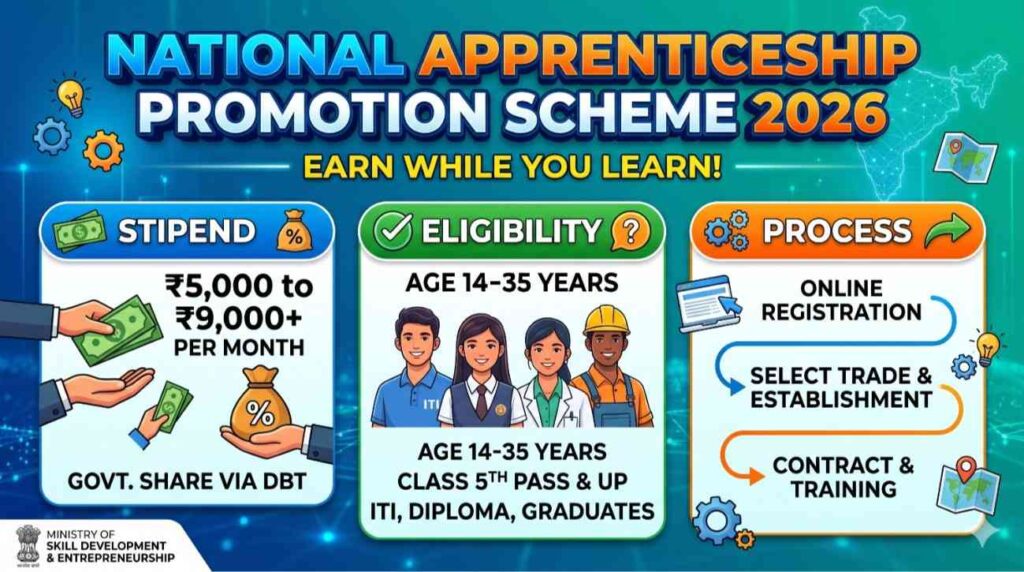
- National Apprenticeship Promotion Scheme 2026: Stipend, Eligibility and Process
- Key Takeaways
- Introduction
- What Is National Apprenticeship Promotion Scheme 2026?
- Key Features and Benefits
- Stipend Structure — Education-Level Wise
- Eligibility Criteria and Required Documents
- How to Apply — Step-by-Step Process
- NAPS 2026 vs Other Skill Schemes — Quick Comparison
- Frequently Asked Questions (FAQ)
- Conclusion
National Apprenticeship Promotion Scheme 2026: Stipend, Eligibility and Process
Meta Description: Complete guide to National Apprenticeship Promotion Scheme 2026 — stipend details, eligibility criteria, registration process, and how to get apprenticeship training with government support. Read the full guide now.
Key Takeaways
- National Apprenticeship Promotion Scheme 2026 provides government-supported on-the-job training with monthly stipend to Indian youth.
- The government reimburses 25% of the stipend amount directly to the employer — encouraging more companies to hire apprentices.
- Candidates from ITI, diploma, graduate, and even Class 5 pass backgrounds are eligible to apply.
- Over 30 lakh apprenticeship seats are available across thousands of government and private sector establishments.
- Registration is completely free and done online through the official portal apprenticeshipindia.org.
Introduction
What if you could earn a monthly stipend while learning a real industry skill — directly inside a company — with the full backing of the Government of India? That is exactly what the National Apprenticeship Promotion Scheme 2026 offers to millions of young Indians. In a job market where employers want experience and freshers struggle to get their first opportunity — NAPS bridges that gap perfectly. It places you inside a real workplace, pays you a stipend every month, gives you a government-recognized National Apprenticeship Certificate at the end, and dramatically improves your chances of getting hired permanently. In 2026, the scheme is bigger and more accessible than ever — covering more sectors, more companies, and more districts across the country. This complete guide breaks down every detail you need — eligibility, stipend structure, sectors covered, and the exact registration process from start to finish.
What Is National Apprenticeship Promotion Scheme 2026?
National Apprenticeship Promotion Scheme 2026 — commonly known as NAPS — is a flagship skill development initiative launched by the Ministry of Skill Development and Entrepreneurship (MSDE), Government of India in August 2016. It operates under the framework of the Apprentices Act 1961 and is implemented through the Directorate General of Training (DGT) in coordination with state apprenticeship advisers across India.
The core idea behind NAPS is simple and powerful — instead of only classroom-based skill training, apprenticeship puts young people directly inside real industries where they learn by doing. This on-the-job training model produces job-ready workers far more effectively than any classroom can.
NAPS covers apprenticeship training across four main categories:
- Trade Apprentices — ITI-qualified candidates trained in specific engineering and non-engineering trades
- Graduate Apprentices — Engineering and technology graduates trained in their respective disciplines
- Technician Apprentices — Diploma holders from polytechnic institutes trained in technical roles
- Fresher / Optional Trade Apprentices — Candidates with basic education (Class 5 to Class 12) trained in optional trades across service and manufacturing sectors
The scheme currently covers over 4,000 establishments including central public sector undertakings, state public sector units, and large private sector companies — with a target of engaging 50 lakh apprentices across India by the end of 2026.
Key Features and Benefits
NAPS 2026 is designed to benefit three groups simultaneously — the apprentice who needs experience, the employer who needs skilled workers, and the nation that needs a productive workforce. Here is what every apprentice receives:
- Monthly Stipend with Government Support — Every apprentice receives a monthly stipend paid by the employer. The government directly reimburses 25% of the stipend amount — up to ₹1,500 per month — to the employer, making it financially attractive for companies to take on apprentices.
- Stipend Scale by Education Level — Stipend amounts are fixed by the government based on the apprentice’s qualification level — ensuring fair and standardized pay across all sectors and establishments.
- National Apprenticeship Certificate (NAC) — On successful completion of the apprenticeship period, candidates receive a nationally recognized NAC from the Directorate General of Training — a credential that significantly strengthens any job application.
- Real Industry Experience — Apprentices work inside actual company environments — on real machines, with real deadlines, and real professional standards — gaining practical experience that no classroom training can replicate.
- Priority in Permanent Hiring — Many NAPS-empanelled companies offer permanent job positions to top-performing apprentices after completion — effectively using the apprenticeship as a working interview.
- Coverage Under ESI and Insurance — Apprentices registered under NAPS receive basic insurance coverage under the Employees State Insurance (ESI) scheme — providing medical and accident protection during the training period.
- Access to Thousands of Establishments — Apprentices can choose from thousands of central PSUs, state PSUs, and private companies listed on the official portal — giving candidates the flexibility to train in their preferred sector and location.
- Free Registration — Zero Cost to Apprentice — The entire NAPS registration process is free of charge for candidates. No application fee, no training fee, and no enrollment charges are ever collected from the apprentice at any stage.
Stipend Structure — Education-Level Wise
Government Fixed Minimum Stipend (2026)
| Education Level | Minimum Monthly Stipend | Govt. Reimbursement (25%) | Apprentice Receives |
|---|---|---|---|
| Class 5 to Class 8 Pass | ₹5,000 | Up to ₹1,250 | ₹5,000+ (employer may pay more) |
| Class 9 to Class 10 Pass | ₹6,000 | Up to ₹1,500 | ₹6,000+ |
| Class 10 + ITI (NCVT) | ₹7,000 | Up to ₹1,500 | ₹7,000+ |
| Class 12 Pass | ₹7,000 | Up to ₹1,500 | ₹7,000+ |
| Diploma Holder (Technician) | ₹8,000 | Up to ₹1,500 | ₹8,000+ |
| Graduate (Any Stream) | ₹9,000 | Up to ₹1,500 | ₹9,000+ |
| Postgraduate / Technical Graduate | ₹10,000 | Up to ₹1,500 | ₹10,000+ |
Government reimbursement is capped at ₹1,500 per month per apprentice regardless of total stipend. Employers may pay higher stipends than the minimum — the government reimburses only 25% up to the cap.
Eligibility Criteria and Required Documents
Eligibility Table
| Apprenticeship Category | Min. Qualification | Age Limit | Additional Condition |
|---|---|---|---|
| Trade Apprentice | ITI pass in relevant trade (NCVT/SCVT) | 14 years minimum | Trade must match the training establishment |
| Graduate Apprentice | Engineering / Technology degree | 16 years minimum | Degree must match the discipline |
| Technician Apprentice | Diploma from polytechnic institute | 16 years minimum | Diploma subject must match training area |
| Optional Trade Apprentice | Class 5 pass to Class 12 pass | 14 years minimum | No specific trade qualification needed |
| Fresher Apprentice | Class 8 pass minimum | 14 years minimum | Available across 250+ optional trades |
No upper age limit is specified under the Apprentices Act 1961 for most categories. Individual establishments may set their own upper age preferences.
Required Documents
- Aadhaar card — mandatory for online registration and stipend transfer
- Educational qualification certificate — ITI, diploma, or degree marksheet
- Class 10 marksheet and passing certificate
- Class 12 marksheet and passing certificate (if applicable)
- ITI National Trade Certificate (NTC) or NCVT certificate (for trade apprentices)
- Caste certificate — SC, ST, or OBC issued by competent authority (if applicable)
- Passport-size photograph — recent, white background, clear face
- Bank account details — account must be Aadhaar-linked for direct stipend transfer
- PwD certificate from government medical board (if applicable)
- Domicile or residential proof — Aadhaar address or utility bill
How to Apply — Step-by-Step Process
Registration under National Apprenticeship Promotion Scheme 2026 is fully online and free of charge. Follow these eight steps carefully:
- Visit the official NAPS portal — Open your browser and go to apprenticeshipindia.org — this is the only official government portal for NAPS 2026 candidate registration, establishment search, and contract management. Avoid all third-party websites completely.
- Click on “Register as Candidate” — On the homepage, find the candidate registration option and click it. Do not use the establishment or assessor registration links — those are for companies and assessment bodies only.
- Enter your Aadhaar-linked mobile number and verify OTP — Type your registered mobile number and complete OTP verification. Aadhaar-based authentication is mandatory for all NAPS registrations in 2026.
- Fill your complete candidate profile — Enter your full name, date of birth, gender, state, district, educational qualification, ITI trade or degree discipline, and preferred sector for apprenticeship training. Fill every field accurately without any abbreviation.
- Upload required documents — Upload your Aadhaar card, educational certificates, photograph, and bank passbook in the format and size specified on the portal. All uploaded documents must be clearly legible — blurry or incomplete scans are rejected during employer verification.
- Search for available apprenticeship openings — Use the portal’s establishment search feature to find companies offering apprenticeship in your trade, sector, district, or state. Filter by location, sector, qualification level, and stipend amount to find the best match for your profile.
- Apply to your preferred establishment — Click “Apply” on the establishments that match your qualification and location preference. You can apply to multiple establishments simultaneously. Employers will review your profile and contact you for further steps.
- Sign the apprenticeship contract and begin training — Once an employer selects you, both parties sign an official apprenticeship contract on the portal. This contract is registered with the state apprenticeship adviser and legally protects your stipend and training rights throughout the entire apprenticeship period.
Pro Tip: Complete your candidate profile 100% before applying to any establishment. Incomplete profiles are consistently rejected by employers during initial screening. Upload all documents in the correct format on day one — a complete, well-filled profile gets shortlisted significantly faster than a partial one.
NAPS 2026 vs Other Skill Schemes — Quick Comparison
| Feature | NAPS 2026 | PMKVY 2026 | ITI Training |
|---|---|---|---|
| Training Type | On-the-job inside real company | Classroom and lab based | Classroom and workshop based |
| Monthly Stipend | ₹5,000 – ₹10,000 (govt. supported) | Travel and food allowance only | No stipend — fee-based |
| Duration | 6 months to 3 years | 2 weeks to 6 months | 1 to 2 years |
| Certificate Issued | National Apprenticeship Certificate (NAC) | NSDC / Sector Skill Council Certificate | NCVT National Trade Certificate |
| Min. Qualification | Class 5 pass | No strict minimum | Class 8 to Class 10 pass |
| Job Placement | Direct — via employer company | Through NSDC placement drives | Through employment exchange |
| Cost to Candidate | Completely free | Completely free | Government or self-funded |
| Managed By | MSDE / DGT | MSDE / NSDC | MSDE / DGT / State Govts |
All details are approximate and based on 2026 official government scheme guidelines.
Frequently Asked Questions (FAQ)
Q1: Who can apply for National Apprenticeship Promotion Scheme 2026? Any Indian citizen who has completed at least Class 5 and is a minimum of 14 years old is eligible to register under National Apprenticeship Promotion Scheme 2026. ITI pass candidates can apply for trade apprenticeships in their specific trade. Diploma holders qualify for technician apprenticeships. Engineering and science graduates qualify for graduate apprenticeships. Even candidates with only Class 8, 10, or 12 qualifications can enroll under the Optional Trade Apprenticeship category across 250+ available trades. There is no strict upper age limit under the Apprentices Act — individual companies may set their own preferences.
Q2: How much stipend will I receive under NAPS 2026? The NAPS stipend 2026 depends on your educational qualification. ITI-qualified trade apprentices receive a minimum of ₹7,000 per month. Diploma holders receive at least ₹8,000 per month. Graduate apprentices receive a minimum of ₹9,000 per month. Class 10 pass candidates under optional trades receive a minimum of ₹6,000 per month. The government directly reimburses 25% of this stipend — up to ₹1,500 per month — to the employer. Many large PSUs and private companies pay stipends higher than the government minimum — especially in sectors like IT, automotive, electronics, and banking.
Q3: Is the National Apprenticeship Certificate valid for government jobs? Yes — the National Apprenticeship Certificate issued by the Directorate General of Training upon NAPS completion is a nationally recognized qualification under the Apprentices Act 1961. It is accepted as a vocational qualification by state and central government recruitment boards. Many state PSU recruitment notifications specifically award extra marks or preference to candidates holding a valid NAC in the relevant trade or discipline. The certificate is also widely accepted by private sector employers, especially in manufacturing, engineering, construction, retail, and hospitality sectors across India.
Q4: Can I register on NAPS 2026 if I am an ITI pass-out? Yes — ITI pass-out candidates are among the most preferred profiles on the NAPS portal. Employers specifically look for ITI-qualified trade apprentices because they already have foundational technical knowledge and can contribute meaningfully from the first week of training. ITI candidates with an NCVT or SCVT National Trade Certificate should register under the “Trade Apprentice” category on apprenticeshipindia.org and search for openings in their specific trade — such as Electrician, Fitter, Welder, COPA, Mechanic, Turner, or any of the 130+ recognized ITI trades listed on the portal.
Q5: How long does the NAPS apprenticeship training period last? The duration of apprenticeship training under NAPS 2026 varies based on the trade and apprenticeship category. Trade apprenticeships for ITI-qualified candidates typically last between 6 months and 1 year. Graduate apprenticeships for engineering degree holders last 1 year as mandated by the Apprentices Act. Technician apprenticeships for diploma holders also last 1 year. Optional trade apprenticeships for Class 5 to 12 pass candidates can range from 6 months to 2 years depending on the trade complexity. Throughout this entire period, the candidate continues receiving the monthly stipend and is legally protected under the registered apprenticeship contract signed on the official portal.
Conclusion
National Apprenticeship Promotion Scheme 2026 is one of the smartest career moves any young Indian can make right now — whether you are a fresh ITI pass-out, a diploma holder, a graduate without experience, or simply someone who wants to build a real skill with real industry exposure and a government-backed monthly stipend. The combination of paid training, a nationally recognized certificate, and a direct pathway to permanent employment makes NAPS genuinely different from any other scheme available today. Register for free today on apprenticeshipindia.org, build your complete profile, and start applying to establishments in your preferred sector and district. If this guide helped you, share it with a friend who is job-hunting, drop your questions in the comments below, and bookmark the official portal for all latest NAPS 2026 openings, establishment listings, and contract updates.