- Mid Day Meal Scheme: How It Works, Benefits and Job Opportunities in 2026
- Key Takeaways
- Introduction
- What Is Mid Day Meal Scheme 2026?
- How Does PM POSHAN Work — Complete Process
- PM POSHAN Nutritional Standards 2026
- Key Features and Benefits
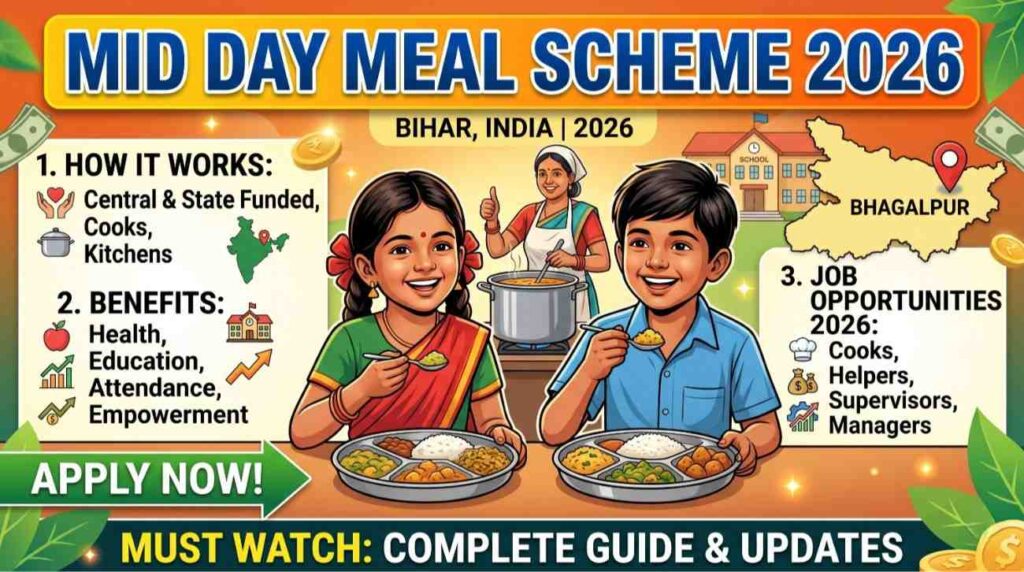
- Job Opportunities Under Mid Day Meal Scheme 2026
- Eligibility Criteria and Required Documents
- How to Apply — Step-by-Step Process
- PM POSHAN vs Other School Welfare Schemes — Quick Comparison
- Frequently Asked Questions (FAQ)
- Conclusion
Mid Day Meal Scheme: How It Works, Benefits and Job Opportunities in 2026
Meta Description: Complete guide to Mid Day Meal Scheme 2026 — how PM POSHAN works, key benefits, nutritional standards, career opportunities, eligibility and step-by-step application process. Read the full guide now.
Key Takeaways
- Mid Day Meal Scheme 2026 — now called PM POSHAN — provides free hot cooked meals to over 12 crore students in government schools daily.
- The scheme covers students from pre-primary to Class 8 across all government and government-aided schools in India.
- PM POSHAN creates lakhs of cook and cook helper jobs across India — a major employment source for women in rural areas.
- The scheme is funded on a 60:40 cost-sharing basis between the central and state governments.
- Cook helpers under the scheme receive a monthly honorarium of ₹1,000 to ₹2,500 depending on the state.
Introduction
Every school morning across India — in a tribal village in Chhattisgarh, a flood-prone district in Bihar, or a remote hill town in Himachal Pradesh — millions of children walk to school partly because they know a hot meal is waiting for them. That meal is made possible by one of the world’s largest school feeding programs — the Mid Day Meal Scheme 2026. Now officially renamed PM POSHAN Shakti Nirman, this central government scheme feeds over 12 crore students every single school day — improving attendance, reducing dropout rates, fighting malnutrition, and creating lakhs of employment opportunities for women in communities across India. Whether you are a student, parent, teacher, job seeker, or policy enthusiast — this complete guide explains exactly how the scheme works, what benefits it delivers, and what career opportunities it creates in 2026.
What Is Mid Day Meal Scheme 2026?
Mid Day Meal Scheme 2026 — officially renamed Pradhan Mantri POSHAN Shakti Nirman (PM POSHAN) in September 2021 — is a centrally sponsored nutrition and school attendance program run by the Ministry of Education, Government of India. It is one of the oldest and largest school meal programs in the world — and in terms of daily beneficiaries, it is the single largest school feeding initiative on the planet.
The scheme was first launched nationally in 1995 under the National Programme of Nutritional Support to Primary Education. Over the decades it expanded from primary schools to upper primary schools, added nutritional standards, introduced cooking infrastructure grants, and in 2021 was upgraded and rebranded as PM POSHAN with an expanded mandate aligned with the National Education Policy 2020.
In 2026 PM POSHAN covers:
- All government and government-aided schools across India
- Pre-primary classes — Bal Vatikas attached to government primary schools
- Classes 1 to 8 — all enrolled students receive free meals on every school day
- Special Training Centers — for out-of-school children being mainstreamed back into education
- Madrasas and Maktabs supported under the Samagra Shiksha Abhiyan
The scheme is implemented through a network of State Implementation Societies, district education officers, block resource coordinators, and individual school management committees — with every meal tracked, monitored, and reported through a dedicated digital platform.
How Does PM POSHAN Work — Complete Process
Understanding how the Mid Day Meal Scheme actually functions from center to classroom helps appreciate both its scale and its complexity:
Step 1 — Central Funding Allocation: The Ministry of Education allocates funds to each state based on student enrollment figures. The central government provides foodgrains — rice and wheat — free of cost through the Food Corporation of India. Cash assistance for cooking costs, cook honorarium, and infrastructure is shared 60:40 between center and state.
Step 2 — State Level Management: Each state sets up a State Implementation Society that receives central funds, sets nutritional menus, hires and manages cook helpers, monitors quality, and coordinates with district education offices across the state.
Step 3 — District and Block Coordination: District Education Officers and Block Resource Coordinators oversee daily meal preparation, ensure foodgrain delivery to schools, conduct quality inspections, and report utilization data to the state society.
Step 4 — School Level Preparation: At each school, a team of cook helpers — typically women from the local community — receive foodgrains, cooking fuel support, and monthly honorarium. They prepare hot cooked meals fresh every school day following the state-prescribed nutritional menu.
Step 5 — Meal Service and Monitoring: Meals are served to students during the midday break. The school headmaster maintains a meal register recording the number of students fed each day. School Management Committees — which include parents — conduct monthly oversight visits to check meal quality and hygiene standards.
Step 6 — Digital Tracking: From 2026 onward, all PM POSHAN data — daily attendance, meals served, foodgrain consumed, cook helper details — is reported through the PM POSHAN Management Information System (MIS) portal — enabling real-time monitoring by district, state, and central government officials.
PM POSHAN Nutritional Standards 2026
The government prescribes specific caloric and nutritional requirements that every school meal must meet:
Nutritional Standards Table
| Level | Calorie Requirement | Protein Requirement | Key Components |
|---|---|---|---|
| Primary (Class 1–5) | Minimum 450 calories | Minimum 12 grams | Rice/wheat + dal + vegetable + milk/egg where available |
| Upper Primary (Class 6–8) | Minimum 700 calories | Minimum 20 grams | Rice/wheat + dal + vegetable + additional protein component |
| Pre-Primary (Bal Vatika) | Minimum 450 calories | Minimum 12 grams | Age-appropriate nutritious meal |
Sample Weekly Menu (Illustrative)
| Day | Primary Menu | Upper Primary Menu |
|---|---|---|
| Monday | Rice + Arhar Dal + Seasonal Sabzi | Rice + Rajma + Sabzi + Chapati |
| Tuesday | Khichdi + Vegetable | Pulao + Dal + Salad |
| Wednesday | Rice + Sambar + Papad | Rice + Chana Dal + Sabzi + Chapati |
| Thursday | Chapati + Dal + Sabzi | Chapati + Mixed Dal + Egg / Soya |
| Friday | Rice + Moong Dal + Vegetable Curry | Rice + Dal + Seasonal Sabzi + Fruit |
Actual menus are set by each state based on local food culture, availability, and seasonal produce. States with higher budgets supplement with milk, eggs, bananas, and other nutritional additions.
Key Features and Benefits
PM POSHAN 2026 delivers benefits that extend far beyond simply feeding children — it touches school attendance, health outcomes, gender equity, and community employment all at once:
- Improved School Attendance — Studies consistently show that the promise of a daily hot meal increases school enrollment and daily attendance — especially for girls and children from the poorest families who might otherwise stay home to help with domestic work or earn wages.
- Reduced Classroom Hunger — Hungry children cannot concentrate. By providing a nutritious meal at midday, PM POSHAN directly improves cognitive attention and learning outcomes in afternoon classes.
- Fighting Child Malnutrition — For millions of children from low-income families, the school meal is the most nutritious meal of their entire day. The scheme provides consistent protein, carbohydrate, and micronutrient support — combating stunting and anemia.
- Reduced Dropout Rates — Students — especially girls in rural India — are more likely to continue attending school when a daily meal incentive exists. The scheme has been linked to measurable reductions in middle-school dropout rates across multiple states.
- Social Inclusion — All children — regardless of caste, religion, or economic background — sit together and eat the same meal. This daily act of shared eating has a powerful social cohesion effect in communities where caste-based food discrimination historically existed.
- Women Employment — The scheme is the largest single source of daily wage employment for rural women in India — with over 25 lakh women employed as cook helpers across the country. These are community-based, locally trusted jobs that provide stable income to women who have few other formal employment options.
- Local Farmer Support — Many states source vegetables, pulses, and grains for PM POSHAN directly from local Self Help Groups and farmers — putting government money back into local agricultural economies.
- Pre-Primary Nutrition Support — The 2026 expansion of PM POSHAN to include Bal Vatika pre-primary classes means children as young as 3 years old in government schools now receive nutritional support — addressing the critical early childhood development window.
Job Opportunities Under Mid Day Meal Scheme 2026
PM POSHAN is not just a welfare scheme — it is a massive employment generator. Here are all the career pathways it creates:
Direct Employment — School Level
| Post | Qualification | Monthly Honorarium | Employer |
|---|---|---|---|
| Cook Helper (Rasoia) | Literate — Class 8 preferred | ₹1,000 – ₹2,500 (varies by state) | School / SMC |
| Head Cook | Class 8 pass + cooking experience | ₹1,500 – ₹3,500 (varies by state) | School / SMC |
| Kitchen Assistant | Class 8 pass | ₹1,000 – ₹2,000 (varies by state) | School / SMC |
Administrative and Monitoring Posts
| Post | Qualification | Salary Range (₹/month) | Level |
|---|---|---|---|
| Block Level Coordinator (PM POSHAN) | Graduate + Computer Knowledge | ₹18,000 – ₹28,000 | Block |
| District Programme Officer | Graduate / Postgraduate | ₹25,000 – ₹40,000 | District |
| Data Entry Operator | 12th Pass + Computer Diploma | ₹15,000 – ₹22,000 | District/Block |
| Accounts Assistant | Graduate in Commerce + Tally | ₹18,000 – ₹28,000 | State/District |
| Quality Monitor / Inspector | Graduate + Nutrition/Food knowledge | ₹20,000 – ₹32,000 | District |
Honorarium and salary amounts vary significantly by state. States like Delhi, Kerala, Tamil Nadu, and Maharashtra pay higher than the national average. Always verify in your specific state notification.
Eligibility Criteria and Required Documents
Eligibility Table
| Post | Min. Qualification | Age Limit | Priority Given To |
|---|---|---|---|
| Cook Helper | Literate — Class 5 to 8 preferred | 18–45 years | Local women from SC/ST/OBC communities |
| Head Cook | Class 8 pass + experience | 18–45 years | Women with prior cooking experience |
| Block Coordinator | Graduate in any stream | 21–40 years | Candidates with computer proficiency |
| District Programme Officer | Postgraduate preferred | 25–45 years | Experience in education/nutrition programs |
| Data Entry Operator | 12th Pass + Computer Diploma | 18–35 years | Typing speed 25+ wpm |
| Accounts Assistant | B.Com + Tally proficiency | 21–35 years | Prior government accounts experience |
Age relaxation — 5 years for SC/ST, 3 years for OBC, 10 years for PwD as per respective state government norms.
Required Documents
- Aadhaar card — mandatory for identity and address verification
- Educational qualification certificate — Class 8 / 10 / 12 / graduation marksheet
- Domicile or residential certificate from district authority
- Caste certificate — SC, ST, or OBC issued by competent authority
- Self Help Group membership certificate — if applicable and preferred by state
- Recent passport-size photograph — white background, clear face
- Bank account passbook — Aadhaar-linked for honorarium transfer
- Experience certificate — for head cook and coordinator posts
- Computer proficiency certificate — for data entry and coordinator posts
- PwD certificate from government medical board if applicable
How to Apply — Step-by-Step Process
PM POSHAN cook helper and administrative posts are recruited at the school, block, and district level. The process varies slightly by state but follows these eight core steps:
- Check your local school or block education office notice board — PM POSHAN cook helper vacancies are often advertised at the school or panchayat level through notice boards, local announcements, and gram sabha meetings rather than through large online portals. Visit your nearest government school or block education office to check for active vacancies.
- Visit your state’s official education or PM POSHAN portal — For administrative posts — Block Coordinator, Data Entry Operator, District Programme Officer — visit your state’s official school education department website or Samagra Shiksha State Society portal. Search for PM POSHAN or Mid Day Meal Scheme recruitment notifications for 2026.
- Download and read the official recruitment notification — Download the full advertisement PDF and read every section carefully — eligibility conditions, vacancy numbers, reservation details, honorarium or salary, and application deadline.
- Obtain the application form — For cook helper posts, collect the physical application form from the school headmaster or block education office. For administrative posts, download the online application form from the state portal or apply directly through the online application link.
- Fill the application form completely and accurately — Enter your personal details, educational qualifications, community category, residential address, bank account details, and any relevant experience. For cook helper posts — mention any prior cooking or food handling experience clearly.
- Attach all required documents — Attach photocopies of your Aadhaar card, educational certificates, domicile certificate, caste certificate, photograph, and bank passbook. For administrative posts, attach experience certificates and computer proficiency certificates as specified.
- Submit your application to the correct authority — For cook helper posts, submit to the school headmaster or School Management Committee. For block and district level posts, submit at the Block Education Office or District Education Office either in person or through the state’s online portal as specified in the notification.
- Attend selection interview or merit verification — Cook helper selection is typically done by the School Management Committee through a local interview and community recommendation process. Administrative posts involve a written test or merit-based shortlisting followed by a personal interview at the block or district level.
Pro Tip: Cook helper posts under PM POSHAN are almost always filled from the local community — women living within the school’s village or ward are given strong preference. If you are applying for a cook helper position, get a recommendation letter from your local panchayat representative or a School Management Committee member — it significantly strengthens your application in the local selection process.
PM POSHAN vs Other School Welfare Schemes — Quick Comparison
| Feature | PM POSHAN 2026 | Samagra Shiksha | PM SHRI Yojana |
|---|---|---|---|
| Primary Focus | Daily nutrition and attendance | Universal school access and quality | Model school infrastructure |
| Students Covered | 12 crore+ (Pre-primary to Class 8) | 25 crore+ (Pre-primary to Class 12) | 1 crore+ (Selected 14,597 schools) |
| Launched | 1995 — renamed PM POSHAN 2021 | 2018–19 | September 2022 |
| Managed By | Ministry of Education | Dept. of School Education | Ministry of Education |
| Funding Model | 60:40 Centre-State | 60:40 Centre-State | 60:40 Centre-State |
| Direct Jobs Created | 25 lakh+ cook helpers | 20,000+ teachers annually | 5,000+ teachers annually |
| Benefit Type | Daily hot meal | Infrastructure + teacher recruitment | School upgradation + jobs |
| Application Portal | State education / school level | State SSA portal | KVS / NVS / state portals |
Details are approximate and based on 2026 official government scheme guidelines.
Frequently Asked Questions (FAQ)
Q1: What is the Mid Day Meal Scheme 2026 and what is its new name? The Mid Day Meal Scheme was officially renamed Pradhan Mantri POSHAN Shakti Nirman — PM POSHAN in September 2021 when the Cabinet approved its continuation and expansion for the period 2021–22 to 2025–26. In 2026 it is in its final year of the current approved phase. PM POSHAN provides free hot cooked meals to over 12 crore students in government and government-aided schools from pre-primary to Class 8 across all states and union territories of India. It is the world’s largest school feeding program by number of daily beneficiaries — larger than similar programs in Brazil, the United States, and all of Europe combined.
Q2: How many children benefit from PM POSHAN every day in 2026? PM POSHAN 2026 provides daily meals to over 12 crore — 120 million — students across more than 11 lakh government and government-aided schools in India on every working school day. This includes students from pre-primary Bal Vatika classes through Class 8 — covering the foundational and preparatory stages of the new NEP 5-3-3-4 school structure. The scheme operates across all 36 states and union territories of India. On any given school day, it is estimated that PM POSHAN serves more hot meals than the combined daily output of the five largest fast food chains operating in India.
Q3: What are the job opportunities under Mid Day Meal Scheme for women in 2026? The Mid Day Meal Scheme 2026 is the single largest source of daily employment for rural women in India. Over 25 lakh women are employed as cook helpers and head cooks across government schools nationwide. These positions are filled from the local community — with strong preference given to women from SC, ST, OBC, and Below Poverty Line families. Cook helpers receive a monthly honorarium ranging from ₹1,000 to ₹2,500 depending on the state — with higher-paying states like Delhi, Kerala, and Tamil Nadu offering significantly more. Administrative posts at block and district level — including Data Entry Operator, Block Coordinator, and Accounts Assistant — provide additional career pathways for women with higher educational qualifications.
Q4: Who is eligible to apply for cook helper jobs under PM POSHAN 2026? Any woman who is a permanent resident of the village or area where the school is located, is between 18 and 45 years of age, is at least literate — preferably Class 8 pass — and belongs to the local community is eligible to apply for cook helper posts under PM POSHAN 2026. Most states give strong priority to women from SC, ST, OBC, and BPL families as well as members of active Self Help Groups registered with the local panchayat. There is no formal written examination for cook helper posts — selection is done by the School Management Committee through a community-based process with input from local panchayat representatives.
Q5: How is the quality of meals monitored under PM POSHAN 2026? Meal quality under PM POSHAN 2026 is monitored through multiple overlapping systems. At the school level, the headmaster maintains a daily meal register recording the number of students fed, foodgrains used, and any quality complaints. School Management Committees — which include elected parent representatives — conduct monthly oversight visits and report quality issues to the block education office. At the district level, District Programme Officers and Quality Monitors conduct surprise inspections of school kitchens and meal service. From 2026, all data is uploaded to the PM POSHAN MIS digital portal — enabling real-time tracking by state and central government officials. Any school reporting consistently poor quality or diversion of foodgrains faces immediate administrative action.
Conclusion
Mid Day Meal Scheme 2026 — PM POSHAN — is quietly doing something extraordinary every single day across India. It is feeding 12 crore children, keeping girls in school, fighting malnutrition, employing 25 lakh women, supporting local farmers, and building social cohesion — all through the simple act of providing a hot cooked meal at lunchtime. For job seekers — especially women in rural communities — it offers the most accessible government employment opportunity available anywhere in India, with no complex exams and no expensive qualifications required. For families, it is a safety net that keeps children in school and learning. For India, it is a daily investment in the health and future productivity of its next generation. If you are looking for a cook helper opportunity or an administrative role under this scheme, visit your nearest government school or block education office today and ask about active PM POSHAN vacancies in your area. Found this guide helpful? Share it with every woman in your community who needs a government job, drop your questions in the comments below, and follow your state education department’s official portal for all latest PM POSHAN recruitment notifications and scheme updates.