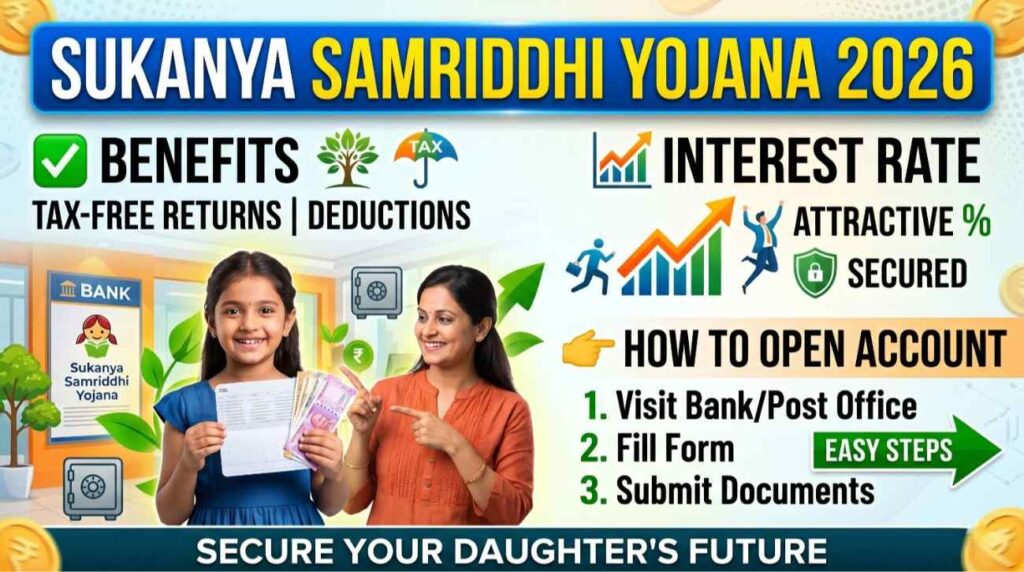
- Sukanya Samriddhi Yojana 2026: Benefits, Interest Rate and How to Open Account
- Key Takeaways
- Introduction
- What Is Sukanya Samriddhi Yojana 2026?
- SSY 2026 Interest Rate and Historical Comparison
- Key Features and Benefits
- Eligibility Criteria and Required Documents
- SSY Deposit Rules and Withdrawal Conditions
- How to Open SSY Account — Step-by-Step Process
- SSY vs Other Small Savings Schemes — Quick Comparison
- Frequently Asked Questions (FAQ)
- Conclusion
Sukanya Samriddhi Yojana 2026: Benefits, Interest Rate and How to Open Account
Key Takeaways
- Sukanya Samriddhi Yojana 2026 offers an interest rate of 8.2% per annum — one of the highest among all small savings schemes in India.
- Parents can open an SSY account for a girl child below 10 years of age with a minimum deposit of just ₹250.
- The maximum deposit allowed per financial year is ₹1,50,000 — eligible for full tax deduction under Section 80C.
- The account matures when the girl child turns 21 years old — with the complete amount paid directly to her.
- Up to 50% of the balance can be withdrawn when the girl turns 18 for higher education expenses.
Introduction
Every parent of a daughter asks one important question sooner or later — “How do I make sure my daughter’s future is financially secure?” The answer that millions of Indian families have found is Sukanya Samriddhi Yojana 2026 — a government-backed savings scheme designed specifically for the girl child that combines the highest available interest rate among small savings schemes, complete tax exemption, and a guaranteed maturity payout that can fund her higher education or wedding. Launched under the Beti Bachao Beti Padhao campaign in 2015, this scheme has already helped over 3 crore families build a secure financial future for their daughters. In 2026, with an interest rate of 8.2% per annum and easy account opening at any post office or authorized bank, there has never been a better time to start. This complete guide explains every detail — benefits, interest rate, deposit rules, withdrawal conditions, tax benefits, and the exact step-by-step process to open an account today.
What Is Sukanya Samriddhi Yojana 2026?
Sukanya Samriddhi Yojana 2026 — commonly known as SSY — is a small savings scheme launched by the Ministry of Finance, Government of India on 22 January 2015 as a core financial component of the Beti Bachao Beti Padhao campaign. The scheme was created with one clear purpose — to encourage parents of girl children to build a dedicated long-term savings corpus that can support their daughter’s higher education and future financial needs.
SSY is operated through two primary channels:
- India Post — Any post office branch across India can open and manage SSY accounts
- Authorized Banks — 28 authorized public and private sector banks including SBI, PNB, Bank of Baroda, Canara Bank, HDFC Bank, ICICI Bank, and Axis Bank
The scheme operates under the Government Savings Promotion Act and all deposits, interest earnings, and maturity amounts are fully guaranteed by the Government of India — making it one of the safest investment instruments available to Indian families regardless of market conditions.
Key facts that define SSY in 2026:
- Account Tenure — 21 years from the date of opening or until the girl’s marriage after age 18
- Deposit Period — Deposits must be made for 15 years from account opening — after that the account continues earning interest without further deposits
- Interest Compounding — Interest is compounded annually and credited at the end of each financial year
- Government Review — Interest rate is reviewed and announced by the Ministry of Finance every quarter
SSY 2026 Interest Rate and Historical Comparison
Current and Historical SSY Interest Rates
| Financial Year | Annual Interest Rate | Compounding |
|---|---|---|
| 2015–16 (Launch) | 9.20% | Annual |
| 2016–17 | 8.60% | Annual |
| 2018–19 | 8.50% | Annual |
| 2020–21 | 7.60% | Annual |
| 2022–23 | 7.60% | Annual |
| 2023–24 | 8.00% | Annual |
| 2024–25 | 8.20% | Annual |
| 2025–26 (Current) | 8.20% | Annual |
The 8.2% interest rate for 2026 is among the highest offered by any government-backed small savings scheme in India — higher than PPF (7.1%), NSC (7.7%), and most fixed deposits at nationalized banks.
SSY Maturity Amount — Illustrative Calculations
| Annual Deposit | Deposit Period | Total Deposited | Approx. Maturity Amount at 8.2% |
|---|---|---|---|
| ₹12,000 (₹1,000/month) | 15 years | ₹1,80,000 | ₹5,45,000+ |
| ₹36,000 (₹3,000/month) | 15 years | ₹5,40,000 | ₹16,35,000+ |
| ₹72,000 (₹6,000/month) | 15 years | ₹10,80,000 | ₹32,70,000+ |
| ₹1,50,000 (Maximum) | 15 years | ₹22,50,000 | ₹68,00,000+ |
Maturity amounts are approximate and calculated at 8.2% annual compounding. Actual amount depends on the exact deposit dates and any future interest rate revisions announced by the Ministry of Finance.
Key Features and Benefits
Sukanya Samriddhi Yojana 2026 is built around a combination of financial security, tax efficiency, and long-term wealth creation for the girl child:
- Highest Interest Rate Among Small Savings — At 8.2% per annum compounded annually, SSY offers the highest guaranteed return of any government small savings scheme — beating PPF, NSC, Post Office Time Deposits, and Kisan Vikas Patra in terms of annual yield.
- Triple Tax Exemption (EEE Status) — SSY enjoys complete tax exemption at all three stages — deposits qualify for deduction under Section 80C up to ₹1.5 lakh per year, interest earned is fully tax-free, and the entire maturity amount is exempt from income tax — making it the most tax-efficient savings instrument available to individual investors in India.
- Government Guarantee on Returns — Unlike mutual funds or market-linked investments, SSY returns are fully guaranteed by the Government of India — there is zero risk of losing principal or interest regardless of economic conditions.
- Flexible Minimum Deposit — The minimum annual deposit is just ₹250 — making the scheme accessible to families across all income levels including daily wage workers and agricultural households.
- High Maximum Deposit Limit — Families can deposit up to ₹1,50,000 per year — allowing higher-income families to build a substantial corpus while also claiming the full Section 80C tax deduction.
- Partial Withdrawal for Education — When the girl child turns 18, parents or the girl herself can withdraw up to 50% of the account balance for higher education expenses — covering college admission, tuition fees, and study costs.
- Account Transferable Across India — If a family relocates to another city, state, or district, the SSY account can be transferred seamlessly to any post office or authorized bank branch across India — ensuring continuity without any penalty.
- Premature Closure on Marriage — If the girl gets married after turning 18, the SSY account can be closed prematurely and the full balance paid out — eliminating the need to wait until age 21 for the maturity amount.
Eligibility Criteria and Required Documents
Eligibility Table
| Criteria | Condition |
|---|---|
| Who Can Open Account | Parent or legal guardian of a girl child |
| Girl Child Age | Below 10 years at time of account opening |
| Number of Accounts Per Girl | Only 1 account allowed per girl child |
| Accounts Per Family | Maximum 2 accounts — one per girl child (3 allowed for twins/triplets) |
| Nationality | Indian citizen girl child residing in India |
| NRI Status | NRI families are not eligible to open new SSY accounts |
| Minimum Annual Deposit | ₹250 per financial year |
| Maximum Annual Deposit | ₹1,50,000 per financial year |
| Account Maturity | 21 years from date of account opening |
| Deposit Period | 15 years from account opening — no deposits needed after year 15 |
Required Documents for Account Opening
- Girl child’s birth certificate — issued by municipal authority or gram panchayat
- Aadhaar card of parent or legal guardian — for identity verification
- Aadhaar card of girl child — if issued
- Parent’s identity proof — voter ID, passport, or PAN card
- Parent’s address proof — ration card, electricity bill, or bank passbook
- Recent passport-size photographs of parent and girl child
- Initial deposit amount — minimum ₹250 in cash, cheque, or demand draft
- PAN card of parent — recommended for deposits above ₹50,000 per year
- Guardianship certificate — if account is opened by a legal guardian other than parent
SSY Deposit Rules and Withdrawal Conditions
Deposit Rules
| Rule | Detail |
|---|---|
| Minimum Deposit Per Year | ₹250 |
| Maximum Deposit Per Year | ₹1,50,000 |
| Deposit Frequency | Any number of times in a year — lump sum or installments |
| Deposit Period | 15 years from account opening date |
| Penalty for Non-Deposit | ₹50 per year penalty — account becomes irregular but can be reactivated |
| Post-15-Year Deposits | Not allowed — account earns interest automatically until maturity |
Withdrawal Rules
| Withdrawal Type | Condition | Amount Allowed |
|---|---|---|
| Partial Withdrawal | Girl child completes 18 years | Up to 50% of previous year-end balance |
| Purpose of Withdrawal | Higher education only | Proof of admission required |
| Premature Closure | Girl’s marriage after 18 years | Full balance paid out |
| Premature Closure | Account holder’s death | Full balance with interest to guardian |
| Premature Closure | Life-threatening illness | Allowed with documentation |
| Full Maturity | Girl completes 21 years | Full balance + interest paid to girl |
How to Open SSY Account — Step-by-Step Process
Opening a Sukanya Samriddhi Yojana account in 2026 is simple and can be done at any post office or authorized bank. Follow these eight steps carefully:
- Choose your preferred account opening location — Visit any post office branch in India or walk into an authorized bank such as SBI, PNB, Bank of Baroda, Canara Bank, HDFC Bank, ICICI Bank, or Axis Bank. Both channels offer identical SSY benefits — choose whichever is most convenient for your location.
- Request the SSY account opening form — Ask the counter staff for the Sukanya Samriddhi Yojana account opening form. You can also download it in advance from the India Post official website at indiapost.gov.in or your bank’s official portal to save time.
- Fill the account opening form completely — Enter the girl child’s full name exactly as on her birth certificate, date of birth, and Aadhaar number. Enter the parent or guardian’s full name, Aadhaar number, address, and contact details. Fill every field clearly — errors in the girl’s name or date of birth cause problems at maturity.
- Attach all required documents — Attach the girl child’s birth certificate, parent’s Aadhaar card, address proof, and passport-size photographs of both parent and child. Attach PAN card copy if your annual deposit will exceed ₹50,000.
- Make your initial deposit — Deposit the opening amount — minimum ₹250, maximum ₹1,50,000 for the financial year — in cash, cheque, demand draft, or online transfer. The account gets activated immediately after the deposit is processed.
- Collect your SSY passbook — After account activation, you will receive a Sukanya Samriddhi Yojana passbook with the account number, opening date, deposit details, and account holder information. Keep this passbook safely — it is required for all future transactions and the final maturity claim.
- Link your account for online access — Most authorized banks allow you to link your SSY account to your internet banking or mobile banking profile. This enables you to make deposits online, check your balance, and download account statements without visiting the branch every time.
- Set up annual deposit reminders — The minimum annual deposit of ₹250 must be made before 31st March every year to keep the account active. Set calendar reminders or standing instructions at your bank to ensure you never miss the annual deposit deadline and incur the ₹50 penalty.
Pro Tip: Always deposit in April at the beginning of each financial year rather than waiting until March. SSY interest is calculated on the lowest balance between the 5th and last day of each month — depositing early in April ensures the full year’s deposit earns maximum interest for all 12 months. Even depositing just a few days early can make a significant difference in the final maturity amount over 15 years of compounding.
SSY vs Other Small Savings Schemes — Quick Comparison
| Scheme | Interest Rate 2026 | Tax Benefit | Tenure | Min. Deposit | Who Can Invest |
|---|---|---|---|---|---|
| Sukanya Samriddhi Yojana | 8.20% | EEE — Full exemption | 21 years | ₹250/year | Parents of girl child below 10 |
| Public Provident Fund (PPF) | 7.10% | EEE — Full exemption | 15 years | ₹500/year | Any Indian individual |
| National Savings Certificate | 7.70% | 80C — deposit only | 5 years | ₹1,000 | Any Indian individual |
| Post Office Time Deposit (5yr) | 7.50% | 80C — deposit only | 5 years | ₹1,000 | Any Indian individual |
| Senior Citizen Savings Scheme | 8.20% | 80C — deposit only | 5 years | ₹1,000 | Age 60 years and above |
| Kisan Vikas Patra | 7.50% | No tax benefit | 9 yr 7 months | ₹1,000 | Any Indian individual |
Interest rates are current as of 2026 and reviewed quarterly by the Ministry of Finance. SSY and SCSS share the highest interest rate among all government small savings schemes.
Frequently Asked Questions (FAQ)
Q1: What is the current Sukanya Samriddhi Yojana interest rate in 2026? The Sukanya Samriddhi Yojana interest rate 2026 is 8.2% per annum, compounded annually and credited at the end of each financial year. This rate is set and reviewed quarterly by the Ministry of Finance — it can be revised upward or downward based on government borrowing rates and broader macroeconomic conditions. At 8.2%, SSY offers the highest guaranteed interest rate among all government small savings schemes available to individual investors in India in 2026 — making it the most rewarding risk-free savings instrument for parents investing for their daughter’s future education and financial security.
Q2: What is the minimum and maximum deposit in Sukanya Samriddhi Yojana 2026? The minimum annual deposit in SSY is ₹250 per financial year — making it accessible to families across all income levels. The maximum annual deposit is ₹1,50,000 per financial year — and any amount deposited up to this limit qualifies for tax deduction under Section 80C of the Income Tax Act. Deposits can be made in any number of installments during the year — weekly, monthly, quarterly, or as a single lump sum — with no restriction on frequency. If the minimum deposit of ₹250 is not made in a financial year, the account becomes irregular and a penalty of ₹50 is charged to reactivate it.
Q3: Can I withdraw money from the SSY account before maturity? Yes — partial withdrawal is allowed under specific conditions before maturity. When the girl child completes 18 years of age, up to 50% of the balance as of the end of the previous financial year can be withdrawn — but only for higher education expenses such as college admission fees or tuition costs. Proof of admission to a recognized institution is required at the bank or post office. Full premature closure is allowed if the girl gets married after turning 18, if the account holder passes away, or in cases of life-threatening illness — with the complete balance including interest paid out immediately after documentation is verified.
Q4: How many SSY accounts can a family open for their daughters? A family can open a maximum of two Sukanya Samriddhi accounts — one for each of two girl children. If the family has twins or triplets as the second birth, all children from that birth are eligible — meaning a family with one older daughter and then twin daughters in the second pregnancy can open three SSY accounts in total. Each account must be opened individually in the name of each girl child and operated by the parent or legal guardian until the girl turns 18. Only one SSY account is permitted per girl child — attempting to open multiple accounts for the same girl is not allowed and such accounts are rejected by the system.
Q5: What are the tax benefits of Sukanya Samriddhi Yojana in 2026? Sukanya Samriddhi Yojana enjoys EEE — Exempt Exempt Exempt tax status — the highest possible tax efficiency available under Indian income tax law. This means three separate tax exemptions apply simultaneously. First — all annual deposits up to ₹1,50,000 qualify for Section 80C deduction from your taxable income. Second — all interest earned on the SSY account every year is completely exempt from income tax — unlike bank fixed deposits where interest is fully taxable. Third — the entire maturity amount received when the account closes at age 21 is 100% tax-free with no TDS deduction. No other savings instrument available in India in 2026 offers this complete triple tax exemption combined with an 8.2% guaranteed return.
Conclusion
Sukanya Samriddhi Yojana 2026 is simply the best government-backed financial gift any parent can give their daughter — a guaranteed 8.2% annual return, complete triple tax exemption, a maturity corpus that can fund her college education or wedding, and the full security of a Government of India guarantee behind every rupee. The minimum deposit is just ₹250 — there is no income barrier and no reason to wait. If your daughter is below 10 years of age, walk into the nearest post office or authorized bank today, carry her birth certificate and your Aadhaar card, and open her SSY account in less than 30 minutes. The earlier you start, the more powerful the compounding — and the larger the financial foundation you build for her future. Found this guide helpful? Share it with every parent of a daughter you know, drop your questions in the comments below, and visit indiapost.gov.in or your nearest bank branch for all latest SSY 2026 deposit rules and account details.