- Eklavya Model Residential School Jobs 2026: Recruitment, Salary and Eligibility
- Key Takeaways
- Introduction
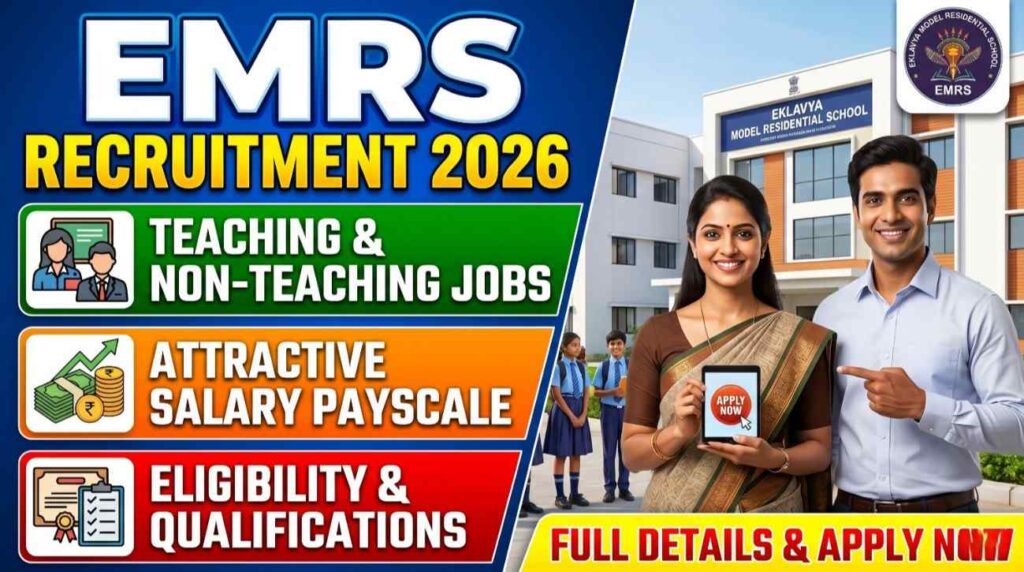
- What Is EMRS Recruitment 2026?
- EMRS 2026 — Post-Wise Vacancy and Salary Details
- Key Features and Benefits of EMRS Jobs
- Eligibility Criteria and Required Documents
- EMRS 2026 Selection Process — Stage by Stage
- How to Apply — Step-by-Step Process
- EMRS vs KVS vs NVS — Residential School Jobs Comparison 2026
- Frequently Asked Questions (FAQ)
- Conclusion
Eklavya Model Residential School Jobs 2026: Recruitment, Salary and Eligibility
Meta Description: Complete guide to Eklavya Model Residential School Jobs 2026 — vacancies, post-wise salary, eligibility criteria, selection process and step-by-step online application process. Read the full guide now.
Key Takeaways
- Eklavya Model Residential School Jobs 2026 offers thousands of teaching and non-teaching vacancies across tribal areas of India.
- EMRS recruitment is conducted by NESTS — National Education Society for Tribal Students — under the Ministry of Tribal Affairs.
- Posts include PGT, TGT, PRT, Principal, Vice Principal, Hostel Warden, and various non-teaching staff.
- Salary follows the 7th Pay Commission structure ranging from ₹35,400 to ₹2,09,200 per month based on post.
- All applications are submitted through the official EMRS portal at emrs.tribal.gov.in — completely online and free.
Introduction
Deep inside India’s tribal heartlands — in the forested districts of Jharkhand, the hills of Odisha, the valleys of Chhattisgarh, and the remote corners of Rajasthan and Madhya Pradesh — a quiet educational revolution is happening. Eklavya Model Residential School Jobs 2026 are at the center of that revolution. Eklavya Model Residential Schools — known as EMRS — are fully residential government schools built exclusively to provide quality education to Scheduled Tribe children in India’s most remote and underserved tribal areas. Every new EMRS school that opens creates dozens of new government teaching and non-teaching vacancies — and in 2026 with over 700 EMRS schools operational or under construction across India, the recruitment pipeline is larger than ever. This is a central government job with 7th Pay Commission salary, free campus accommodation, permanent service status, and the rare privilege of making a transformational difference in the lives of India’s tribal children. This complete guide gives you every detail — post-wise vacancies, salary structure, eligibility conditions, and the exact steps to apply.
What Is EMRS Recruitment 2026?
EMRS Recruitment 2026 is the hiring process conducted by the National Education Society for Tribal Students (NESTS) — an autonomous body under the Ministry of Tribal Affairs, Government of India — to staff Eklavya Model Residential Schools across India’s scheduled tribal areas.
Eklavya Model Residential Schools were first conceptualized in 1997–98 with the vision of providing quality education to ST children in remote tribal districts — education that would be comparable to the best residential schools in India, completely free of cost for enrolled tribal students. The scheme draws its name from Eklavya — the self-taught archer from the Mahabharata — symbolizing the untapped potential of India’s tribal youth.
In 2018 the Government of India announced a massive expansion of EMRS — committing to establishing one EMRS in every block with more than 50% ST population and at least 20,000 tribal residents. By 2026 this means:
- Over 740 EMRS schools sanctioned across 27 states and union territories
- More than 3.5 lakh ST students enrolled in operational EMRS schools
- Thousands of teaching and non-teaching vacancies generated every year as new schools open and existing schools expand capacity
All EMRS schools follow the CBSE curriculum from Class 6 to Class 12 and are fully residential — providing free accommodation, food, uniforms, textbooks, and education to all enrolled tribal students. Managing these schools requires a large, qualified, and dedicated workforce — which is where EMRS Recruitment 2026 comes in.
NESTS conducts centralized recruitment for all EMRS schools across India — meaning one application covers vacancies in all states where EMRS schools are located.
EMRS 2026 — Post-Wise Vacancy and Salary Details
Teaching Posts
| Post | Classes Covered | Approx. Vacancies | Pay Level | Salary Range (₹/month) |
|---|---|---|---|---|
| Post Graduate Teacher (PGT) | Classes 11 to 12 | 2,800+ | Level 8 | ₹47,600 – ₹1,51,100 |
| Trained Graduate Teacher (TGT) | Classes 6 to 10 | 3,500+ | Level 7 | ₹44,900 – ₹1,42,400 |
| Primary Teacher (PRT) | Classes 1 to 5 | 1,200+ | Level 6 | ₹35,400 – ₹1,12,400 |
| TGT Physical Education | Classes 6 to 12 | 600+ | Level 7 | ₹44,900 – ₹1,42,400 |
| TGT Art Education | Classes 6 to 10 | 300+ | Level 7 | ₹44,900 – ₹1,42,400 |
| PGT Computer Science | Classes 11 to 12 | 400+ | Level 8 | ₹47,600 – ₹1,51,100 |
Administrative and Leadership Posts
| Post | Approx. Vacancies | Pay Level | Salary Range (₹/month) |
|---|---|---|---|
| Principal | 250+ | Level 12 | ₹78,800 – ₹2,09,200 |
| Vice Principal | 350+ | Level 10 | ₹56,100 – ₹1,77,500 |
Non-Teaching and Hostel Posts
| Post | Approx. Vacancies | Pay Level | Salary Range (₹/month) |
|---|---|---|---|
| Hostel Warden | 800+ | Level 6 | ₹35,400 – ₹1,12,400 |
| Female Staff Nurse | 600+ | Level 7 | ₹44,900 – ₹1,42,400 |
| Junior Secretariat Assistant (JSA) | 500+ | Level 4 | ₹25,500 – ₹81,100 |
| Accountant | 300+ | Level 5 | ₹29,200 – ₹92,300 |
| Lab Assistant | 400+ | Level 2 | ₹19,900 – ₹63,200 |
| Multi-Tasking Staff (MTS) | 700+ | Level 1 | ₹18,000 – ₹56,900 |
| Cook | 500+ | Level 1 | ₹18,000 – ₹56,900 |
| Computer Instructor | 350+ | Level 4 | ₹25,500 – ₹81,100 |
All vacancy figures are approximate and based on 2026 NESTS official projections. Final confirmed vacancies are published in the official recruitment notification on emrs.tribal.gov.in. Salaries follow the 7th Pay Commission central government pay matrix.
Key Features and Benefits of EMRS Jobs
Working in an Eklavya Model Residential School is one of the most uniquely rewarding government job experiences available in India — combining strong financial benefits with deep community impact:
- 7th Pay Commission Central Government Salary — All EMRS employees receive structured salaries under the central government 7th Pay Commission pay matrix — the same pay structure that governs KVS and NVS employees — with regular DA revisions.
- Free Residential Campus Accommodation — Since all EMRS schools are fully residential campuses located in remote tribal areas, teachers and non-teaching staff receive free or heavily subsidized on-campus housing — a benefit worth ₹15,000 to ₹30,000 per month in equivalent value.
- Free Campus Meals — Staff posted at EMRS residential campuses receive subsidized meals through the school’s centralized catering system — significantly reducing personal living expenses.
- Permanent Central Government Status — EMRS employees hold permanent central government service status after completing the probation period — one of the most secure employment positions available in India.
- National Pension System (NPS) — All EMRS employees are covered under NPS with government contribution — ensuring a structured retirement income stream after superannuation.
- Central Government Health Scheme (CGHS) — EMRS employees and their immediate families receive cashless medical treatment at all CGHS-empanelled hospitals across India.
- Child Education Allowance — EMRS employees receive central government child education allowance for up to two children studying in recognized schools — reimbursing tuition and fee expenses annually.
- Deep Professional Purpose — Teaching tribal students who have never had access to quality education creates a level of professional fulfillment that few urban teaching positions can match — making EMRS one of the most purposeful government jobs in India.
Eligibility Criteria and Required Documents
Eligibility Table
| Post | Min. Qualification | Additional Requirement | Age Limit |
|---|---|---|---|
| PGT All Subjects | Postgraduate (50%) in subject + B.Ed | CTET Paper 2 preferred | 21–40 years |
| PGT Computer Science | MCA / M.Sc CS / B.Tech CS/IT | — | 21–40 years |
| TGT All Subjects | Graduate (50%) in subject + B.Ed | CTET Paper 2 mandatory | 18–35 years |
| TGT Physical Education | Graduate + B.P.Ed Degree | — | 18–35 years |
| PRT | 12th Pass (50%) + D.El.Ed | CTET Paper 1 mandatory | 18–30 years |
| Principal | Postgraduate + B.Ed + 15 yrs exp. | — | Up to 50 years |
| Vice Principal | Postgraduate + B.Ed + 10 yrs exp. | — | Up to 45 years |
| Hostel Warden | Graduate + experience in hostel/welfare | — | 21–40 years |
| Female Staff Nurse | B.Sc Nursing or GNM + RNC | Valid RNC registration | 18–35 years |
| JSA / Accountant | 12th Pass / B.Com | Computer and typing proficiency | 18–30 years |
| Lab Assistant | 12th Science + ITI / B.Sc | — | 18–30 years |
| MTS / Cook | 10th Pass (Matriculation) | — | 18–30 years |
Age relaxation — 5 years for SC/ST candidates, 3 years for OBC, 10 years for PwD as per central government norms. Candidates with prior experience in tribal areas or residential schools may receive additional preference in some states.
Required Documents
- Aadhaar card — mandatory for identity and address verification
- 10th and 12th marksheets with passing certificates
- Graduation and postgraduate degree certificate with all semester marksheets
- B.Ed or D.El.Ed degree certificate or university-issued provisional certificate
- Valid CTET certificate — Paper 1 for PRT, Paper 2 for TGT
- Experience certificate — mandatory for Principal and Vice Principal posts
- RNC registration certificate — for Female Staff Nurse posts
- Caste certificate — SC, ST, or OBC issued by competent district authority
- PwD certificate from government medical board if applicable
- Computer proficiency and typing certificate — for JSA and Accountant posts
- ITI or B.Sc certificate — for Lab Assistant posts
- Recent passport-size photograph — white background clear face
- Scanned signature on plain white paper in required format and file size
- Bank account details linked to Aadhaar for fee payment and salary processing
EMRS 2026 Selection Process — Stage by Stage
NESTS follows a comprehensive multi-stage selection process for all EMRS posts ensuring only the most qualified and committed candidates are appointed:
Stage 1 — Written Examination (Computer Based Test): NESTS conducts a centralized CBT online for all teaching and administrative posts. The exam includes sections on General Awareness, Reasoning Ability, General English, General Hindi, and Subject-Specific Knowledge. For TGT and PGT posts the subject knowledge section carries the highest weightage. For non-teaching posts the exam covers General Knowledge, Reasoning, English, and relevant vocational knowledge.
Stage 2 — Skill Test (For Specific Posts): JSA, Accountant, and Computer Instructor candidates must appear for a computer proficiency and typing speed test after clearing the written exam. Female Staff Nurse candidates undergo a practical clinical skills assessment at a designated government medical facility.
Stage 3 — Personal Interview: Candidates shortlisted from the written examination are called for a structured personal interview conducted by a NESTS Selection Committee. The interview assesses subject knowledge depth, communication quality, understanding of tribal education challenges, teaching philosophy, and willingness to serve in remote residential school environments.
Stage 4 — Document Verification: All original documents — degrees, CTET certificate, experience letters, caste certificate, and identity proof — are verified physically at the NESTS regional office before final appointment orders are issued.
For MTS and Cook posts — only a written objective test is conducted. No interview or skill test is held and final selection is based entirely on written exam merit.
How to Apply — Step-by-Step Process
All applications for EMRS Recruitment 2026 are submitted online through the official NESTS portal. Follow these eight steps without skipping any:
- Visit the official EMRS recruitment portal — Open your browser and go to emrs.tribal.gov.in — the only official government portal for all EMRS 2026 recruitment notifications, online applications, admit card downloads, and result announcements. Avoid all third-party job portals and recruitment agents completely.
- Download and read the complete official notification PDF — Navigate to the “Recruitment” section and download the full 2026 notification for your target post. Read every page without skipping — eligibility conditions, vacancy details, exam pattern, reservation matrix, important dates, application fee, and syllabus.
- Click on “Apply Online” for your selected post — Find the active online application link for your specific post — PGT, TGT, PRT, Principal, Hostel Warden, or non-teaching — and click to begin the registration and application process.
- Complete your new user registration — Enter your full name exactly as it appears on your Aadhaar card, date of birth, working mobile number, and email ID. Create a strong password and save your login credentials in a secure location immediately after registration.
- Fill the application form with complete accuracy — Log in and complete all sections — personal details, permanent address, educational qualifications, CTET certificate details, work experience, category, and state preference. Review every field thoroughly before proceeding — errors in qualification details or CTET certificate numbers cause rejection at document verification.
- Upload all required documents correctly — Scan and upload your photograph, signature, educational certificates, CTET scorecard, caste certificate, and experience certificates in the exact file format, pixel dimensions, and maximum file size specified in the official notification. Incorrectly formatted or oversized uploads are rejected automatically without any warning message.
- Pay the application fee through online payment — Complete fee payment using UPI, debit card, credit card, or net banking. Fee structure: General/OBC/EWS — ₹1,500 · SC/ST — ₹750 · PwD — Fully Exempt. The fee is non-refundable under any circumstance once payment is successfully processed.
- Submit your application and download the confirmation page — After clicking “Final Submit” review your complete application one final time. Download and print your application confirmation page immediately. Note your application reference number and keep it safely — it is required for admit card download, result checking, interview call letter, and all future communication with NESTS regarding your EMRS 2026 application.
Pro Tip: EMRS schools are located in remote tribal districts — often in forested, hilly, or geographically isolated areas. During the personal interview stage, the selection committee specifically evaluates a candidate’s genuine willingness and psychological readiness to live and work in remote residential school environments away from city amenities. Candidates who research the EMRS mission, understand tribal education challenges, and articulate a genuine commitment to tribal student welfare consistently perform better in interviews than technically qualified candidates who appear reluctant about remote postings.
EMRS vs KVS vs NVS — Residential School Jobs Comparison 2026
| Feature | EMRS 2026 | KVS 2026 | NVS 2026 |
|---|---|---|---|
| Conducting Body | NESTS — Ministry of Tribal Affairs | KVS — Ministry of Education | NVS — Ministry of Education |
| Target Students | ST children — tribal areas | Central govt. employee children | Rural talented children |
| School Type | Fully residential — tribal locations | Non-residential — urban and semi-urban | Fully residential — rural districts |
| Number of Schools | 740+ operational or under construction | 1,200+ schools | 661 schools |
| Approx. Vacancies | 10,000+ per year | 8,000+ per year | 7,000+ per year |
| Campus Accommodation | Yes — free residential quarters | No — HRA provided | Yes — free residential quarters |
| Free Campus Meals | Yes — subsidized | No | Yes — subsidized |
| Salary TGT Level | ₹44,900 – ₹1,42,400/month | ₹44,900 – ₹1,42,400/month | ₹44,900 – ₹1,42,400/month |
| Salary PGT Level | ₹47,600 – ₹1,51,100/month | ₹47,600 – ₹1,51,100/month | ₹47,600 – ₹1,51,100/month |
| Application Portal | emrs.tribal.gov.in | kvsangathan.nic.in | nvs.ac.in |
| Competition Level | National — moderate | National — high | National — high |
All figures are approximate and based on 2026 official notifications. Always verify exact salary and vacancy details on respective official portals.
Frequently Asked Questions (FAQ)
Q1: What is EMRS and who conducts EMRS Recruitment 2026? Eklavya Model Residential Schools (EMRS) are fully residential CBSE-affiliated government schools established exclusively for Scheduled Tribe children in India’s tribal districts — providing free quality education, accommodation, food, and healthcare to enrolled students. EMRS Recruitment 2026 is conducted by NESTS — National Education Society for Tribal Students — an autonomous organization under the Ministry of Tribal Affairs, Government of India. NESTS manages all centralized recruitment for teaching and non-teaching posts across all 740+ EMRS schools in 27 states and union territories — meaning one application through emrs.tribal.gov.in covers vacancies across all states simultaneously.
Q2: Is CTET mandatory for EMRS teaching posts in 2026? Yes — CTET is mandatory for TGT level teaching posts in EMRS Recruitment 2026. TGT candidates teaching Classes 6 to 10 must hold a valid CTET Paper 2 certificate. PRT candidates teaching Classes 1 to 5 must hold CTET Paper 1. For PGT posts covering Classes 11 and 12, CTET Paper 2 is preferred and carries additional marks during evaluation — though it is not always strictly mandatory depending on the specific notification. CTET certificates are now permanently valid as per the Government of India’s lifetime validity order — so candidates who cleared CTET in any previous year are fully eligible without needing to reappear. Physical Education, Art Education, and Computer Science posts have specific alternative qualification requirements detailed in the official notification.
Q3: Do EMRS teachers get free accommodation and meals at the school campus? Yes — this is one of the most distinctive benefits of EMRS jobs. Since all Eklavya Model Residential Schools are located on dedicated campuses in remote tribal districts — often far from the nearest town or city — NESTS provides free or heavily subsidized residential quarters to all teaching and non-teaching staff posted at EMRS campuses. The accommodation includes furnished or semi-furnished housing units within the school campus boundary. Staff living on campus also receive subsidized meals through the school’s centralized catering facility. This combination of free housing and subsidized food significantly reduces personal living expenses — making the effective total compensation package for EMRS staff considerably higher than the cash salary figure alone.
Q4: Can candidates from any state in India apply for EMRS Recruitment 2026? Yes — EMRS Recruitment 2026 is open to candidates from all states and union territories across India without any domicile restriction. Unlike SSA and RMSA state-level recruitment where candidates must hold a domicile certificate of the specific state, EMRS recruitment is a central government process conducted by NESTS — making it fully open to qualified candidates regardless of which state they are from. This means candidates from any state can apply for EMRS vacancies in any other state. However candidates should be genuinely prepared for posting in remote tribal districts — which may be very different geographically and culturally from their home state. Willingness to serve in remote locations is evaluated during the personal interview stage.
Q5: What is the EMRS Hostel Warden post and what are the eligibility conditions? The Hostel Warden post in EMRS Recruitment 2026 is a non-teaching residential position responsible for managing the student hostel at an Eklavya Model Residential School campus. Since all EMRS schools are fully residential — students live on campus year-round — the Hostel Warden plays a critical role in student welfare, discipline, health monitoring, and daily residential life management. Eligibility requires a graduate degree in any discipline along with relevant experience in hostel administration, student welfare, or community care work. Age limit is typically 21 to 40 years with standard government relaxation for SC/ST and OBC candidates. The post carries a salary of ₹35,400 to ₹1,12,400 per month at Pay Level 6 along with free on-campus accommodation and subsidized meals — making it one of the most comprehensive non-teaching government job packages available.
Conclusion
Eklavya Model Residential School Jobs 2026 represent a rare combination that very few government positions in India can offer — strong central government salary under the 7th Pay Commission, free campus accommodation, permanent job security, CGHS medical coverage, and the profound professional satisfaction of teaching tribal children who need quality education the most. With over 740 EMRS schools operational or under construction across 27 states and thousands of vacancies across teaching, hostel, nursing, and administrative categories — 2026 is one of the biggest years for EMRS recruitment in the scheme’s history. Start your preparation today — download the official notification from emrs.tribal.gov.in, verify your CTET eligibility and subject qualification, gather all your documents, and submit your application the moment the registration window opens. Found this guide helpful? Share it with every teacher aspirant you know, drop your questions in the comments below, and bookmark emrs.tribal.gov.in for all latest EMRS 2026 vacancy notifications, exam dates, and admit card download updates.