- National Means cum Merit Scholarship 2026: Full Application Guide for Students
- Key Takeaways
- Introduction
- What Is National Means cum Merit Scholarship 2026?
- NMMS 2026 — Scholarship Amount and Coverage Details
- NMMS 2026 Exam Pattern — Complete Breakdown
- Key Features and Benefits
- Eligibility Criteria and Required Documents
- NMMS 2026 Important Dates Calendar
- How to Apply — Step-by-Step Process
- NMMS vs Other Government Scholarships — Quick Comparison
- Frequently Asked Questions (FAQ)
- Conclusion
National Means cum Merit Scholarship 2026: Full Application Guide for Students
Meta Description: Complete guide to National Means cum Merit Scholarship 2026 — eligibility, exam pattern, scholarship amount, required documents and step-by-step online application process. Read the full guide now.
Key Takeaways
- National Means cum Merit Scholarship 2026 provides ₹12,000 per year to meritorious students from Class 9 to Class 12.
- The scholarship is awarded to Class 8 students of government schools through a state-level selection exam.
- Family annual income must be below ₹3.5 lakh to qualify — no community or caste restriction applies.
- The NMMS exam has two papers — Mental Ability Test (MAT) and Scholastic Aptitude Test (SAT).
- Applications are submitted through the official National Scholarship Portal at scholarships.gov.in — completely free.
Introduction
Every year lakhs of bright students studying in government schools across India face a difficult reality — their family simply cannot afford to keep them in school after Class 8. The National Means cum Merit Scholarship 2026 was created specifically to solve this problem. Known widely as NMMS, this central government scholarship targets the most critical dropout risk point in India’s education system — the transition from upper primary to secondary school — and provides a guaranteed ₹12,000 per year to meritorious students from economically weaker families to keep them studying from Class 9 all the way through Class 12. Unlike most government scholarships that are restricted to specific communities, NMMS is open to students from all communities and all categories — the only requirements are academic merit, government school enrollment, and family income below ₹3.5 lakh per year. This complete guide covers everything — exam pattern, eligibility, scholarship amount, renewal rules, and the exact application process for 2026.
What Is National Means cum Merit Scholarship 2026?
National Means cum Merit Scholarship 2026 — officially abbreviated as NMMSS and commonly known as NMMS — is a centrally sponsored scholarship scheme launched by the Ministry of Education, Government of India in the academic year 2008–09. It is implemented through the Department of School Education and Literacy and administered at the state level by each State Education Board or State Scholarship Authority.
The scheme was designed with one specific and powerful goal — prevent dropout at the Class 8 to Class 9 transition stage among meritorious students from economically weaker sections who study in government schools. Research showed that this transition point was where India lost the highest number of bright students from poor families — and NMMS was built to bridge that gap with direct financial support.
Key defining characteristics of NMMS 2026:
- Who is it for — Meritorious students currently in Class 8 at government or government-aided schools
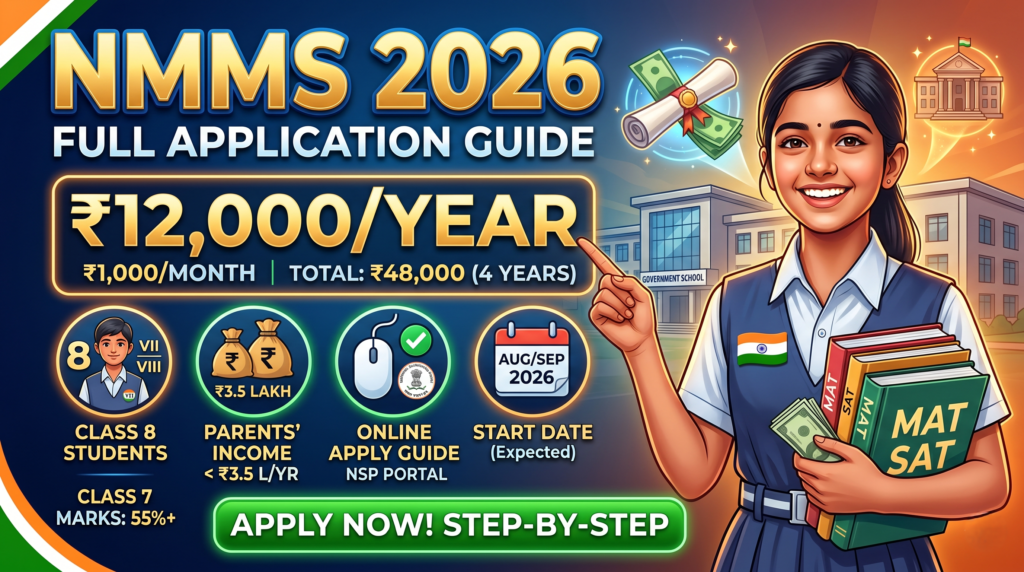
- What it gives — ₹12,000 per year — paid as ₹1,000 per month for 12 months
- For how long — From Class 9 through Class 12 — a total of 4 years of continuous support
- How are students selected — Through a competitive state-level examination conducted by each State Education Board
- Is it community-specific — No — open to students from all communities including General, OBC, SC, ST, and Minority
- Who manages it — Ministry of Education at the central level with state boards handling exam and selection
In 2026 the scheme awards scholarships to approximately 1 lakh students per year across all states and union territories — making it one of the most widely distributed merit-based government school scholarships in India.
NMMS 2026 — Scholarship Amount and Coverage Details
Scholarship Amount Structure
| Detail | Information |
|---|---|
| Annual Scholarship Amount | ₹12,000 per year |
| Monthly Equivalent | ₹1,000 per month |
| Coverage Period | Class 9 to Class 12 — 4 years total |
| Total Maximum Benefit | ₹48,000 over 4 years |
| Payment Mode | Direct Benefit Transfer — Aadhaar-linked bank account |
| Payment Frequency | Quarterly or annual — varies by state |
| Tax Liability | Fully tax-free — no TDS deducted |
State-Wise Scholarship Seat Allocation (Top States)
| State | Approx. NMMS Seats Per Year | Exam Conducting Body |
|---|---|---|
| Uttar Pradesh | 15,000+ | SCERT Uttar Pradesh |
| Maharashtra | 10,000+ | MSCE Pune |
| Madhya Pradesh | 8,000+ | MPBSE |
| Rajasthan | 7,500+ | RBSE |
| Bihar | 6,000+ | BSEB |
| Tamil Nadu | 5,500+ | DGE Tamil Nadu |
| Karnataka | 5,000+ | KSEAB |
| West Bengal | 4,500+ | WBBPE |
Total national NMMS seat allocation is approximately 1 lakh per year distributed across all states and union territories in proportion to their Class 8 enrollment in government schools.
NMMS 2026 Exam Pattern — Complete Breakdown
The NMMS selection exam is conducted at the state level — each state’s education board or SCERT administers the exam independently. The exam has two separate papers conducted on the same day:
Paper 1 — Mental Ability Test (MAT)
| Feature | Detail |
|---|---|
| Total Questions | 90 questions |
| Total Marks | 90 marks |
| Duration | 90 minutes |
| Question Type | Multiple Choice Questions — 1 mark each |
| Negative Marking | No negative marking |
| Topics Covered | Analogy, classification, numerical series, pattern perception, hidden figures, logical reasoning, verbal and non-verbal reasoning |
Paper 2 — Scholastic Aptitude Test (SAT)
| Feature | Detail |
|---|---|
| Total Questions | 90 questions |
| Total Marks | 90 marks |
| Duration | 90 minutes |
| Question Type | Multiple Choice Questions — 1 mark each |
| Negative Marking | No negative marking |
| Topics Covered | Science — 35 questions · Social Studies — 35 questions · Mathematics — 20 questions |
| Syllabus Level | Class 7 and Class 8 NCERT curriculum |
Combined Exam Summary
| Feature | Detail |
|---|---|
| Total Marks | 180 marks — 90 MAT + 90 SAT |
| Total Duration | 3 hours — 90 minutes per paper with break |
| Exam Mode | Offline — OMR-based pen and paper |
| Exam Language | Available in regional state language and English |
| Qualifying Marks General | Minimum 40% in each paper — 36 out of 90 |
| Qualifying Marks SC/ST/PwD | Minimum 32% in each paper — 29 out of 90 |
| Final Merit | Combined MAT + SAT score determines final rank |
Key Features and Benefits
NMMS 2026 stands apart from most government scholarship schemes because of its unique combination of merit-based selection, universal community eligibility, and long-term multi-year support:
- Open to All Communities — Unlike SC, ST, OBC, or Minority-specific scholarships, NMMS is open to students from every community — General, OBC, SC, ST, EWS, and Minority — as long as they meet the income and merit criteria. This makes it genuinely inclusive.
- Four Year Continuous Support — NMMS provides ₹12,000 every year for four consecutive years — from Class 9 through Class 12 — giving students a reliable financial foundation throughout their entire secondary and senior secondary school education.
- Merit-Based Recognition — Holding an NMMS scholarship is a mark of academic achievement and intellectual ability. It is recognized by colleges, universities, and employers as evidence of demonstrated merit at the national level.
- No Community Restriction — Students from upper castes and general category families who are economically weak — with income below ₹3.5 lakh — can access this scholarship even though they may be excluded from community-specific scholarships like SC, ST, or OBC schemes.
- Direct Bank Transfer — The full ₹12,000 annual scholarship is transferred directly to the student’s Aadhaar-linked bank account through DBT — completely bypassing institutions and ensuring the student receives every rupee.
- No Tuition Fee Condition — Unlike some scholarships that require students to be enrolled in specific types of institutions, NMMS supports students in any recognized government or government-aided school for Class 9 to 12.
- Competitive Exam Experience — Preparing for and clearing the NMMS state-level exam builds a strong foundation in reasoning, mathematics, science, and social studies — skills that directly benefit students in later competitive exams like JEE, NEET, and board exams.
- Renewal Based on Academic Performance — The scholarship is renewed automatically each year for students who maintain the required minimum academic performance — creating a healthy incentive for continued academic excellence.
Eligibility Criteria and Required Documents
Eligibility Table — 2026
| Criteria | Condition |
|---|---|
| Current Class | Must be studying in Class 8 at time of application |
| School Type | Government school, government-aided school, or local body school only |
| Previous Class Marks | Minimum 55% marks in Class 7 annual examination |
| SC/ST Marks Relaxation | Minimum 50% marks in Class 7 for SC and ST students |
| Family Annual Income | Below ₹3.5 lakh per year from all sources combined |
| Nationality | Indian citizen studying in India |
| Private School Students | Not eligible — private unaided school students cannot apply |
| Navodaya/Sainik/KV Students | Not eligible — students of NVS, Sainik Schools, and KVS cannot apply |
| Residential School Students | Not eligible — students of state government residential schools not eligible |
| Renewal Eligibility Class 10 | Minimum 55% in Class 9 annual exam — 50% for SC/ST |
| Renewal Eligibility Class 11 | Must pass Class 10 board exam with minimum 60% — 55% for SC/ST |
| Renewal Eligibility Class 12 | Must pass Class 11 annual exam with minimum 55% — 50% for SC/ST |
Required Documents
- Aadhaar card of student — mandatory for DBT scholarship transfer
- Class 7 marksheet showing minimum 55% marks — 50% for SC/ST
- Family income certificate issued by tehsildar or competent revenue authority
- School enrollment certificate or bonafide student certificate from Class 8 school
- Caste certificate — SC/ST/OBC — for marks relaxation benefit only — not for community eligibility
- Bank account passbook — account in student’s name and Aadhaar-linked
- NMMS state exam admit card and scorecard after exam
- Recent passport-size photograph — white background clear face
- Parent or guardian Aadhaar card and identity proof
- PwD certificate from government medical board — for qualifying marks relaxation
NMMS 2026 Important Dates Calendar
| Activity | Typical Timeline |
|---|---|
| State NMMS Exam Notification Released | August – September 2026 |
| School-Level Application Submission | September – October 2026 |
| NMMS State Exam Date | November 2026 |
| State Result Announcement | February – March 2027 |
| NSP Scholarship Registration Window | March – May 2027 |
| Institute Verification Deadline | May – June 2027 |
| First Scholarship Disbursement | July – August 2027 |
| Annual Renewal Window | August – October 2026 (for existing holders) |
Exact dates vary by state — some states conduct NMMS exam in October while others conduct it in November or December. Always check your state education board’s official portal for state-specific exam dates and application deadlines.
How to Apply — Step-by-Step Process
NMMS 2026 application involves two distinct stages — first applying for the state-level exam through your school, and then registering on NSP after qualifying. Follow these eight steps without skipping any:
- Get the NMMS application form from your school — The NMMS exam application is collected at the school level — not directly by individual students. Visit your Class 8 school’s headmaster or scholarship coordinator and request the NMMS 2026 application form as soon as the state notification is released in August or September 2026.
- Fill the school-level application form completely — Fill your full name exactly as on Aadhaar, date of birth, parent details, family income, Aadhaar number, bank account details, and Class 7 marks. Attach your Class 7 marksheet, income certificate, Aadhaar card, and caste certificate — then submit to your school before the internal deadline.
- Your school submits the application to the district education office — The school consolidates all eligible student applications and forwards them to the District Education Office. Ensure your school has submitted your application by confirming with the headmaster. Schools sometimes miss submitting on time — follow up proactively.
- Download your NMMS admit card from the state board portal — After the district education office processes applications, admit cards are released on your state education board’s official website. Download and print your admit card — it contains your exam center details, roll number, and reporting time.
- Appear for the NMMS state-level exam — Appear for both Paper 1 — MAT — and Paper 2 — SAT — on the official exam date in November 2026. Carry your printed admit card and a government-issued photo ID. Attempt all questions — there is no negative marking so never leave any question unanswered.
- Check your state result and qualify — After the state result is announced in February or March 2027, check your score on your state board’s official portal. Students who meet the qualifying cutoff and fall within the seat allocation for their state are declared NMMS scholars.
- Register on National Scholarship Portal after qualifying — Go to scholarships.gov.in and complete fresh student registration using your Aadhaar-linked mobile number and bank account details. Log in and apply for the NMMS scholarship scheme — enter your state exam roll number, score, and all personal details accurately.
- Get institute verification completed on NSP — After submitting your NSP application, your Class 9 school must log into NSP and verify your enrollment before the verification deadline. Visit your school’s principal immediately after NSP submission and request them to complete the online verification. Track your application status weekly on the NSP portal until you see “Verified by Institute” confirmed on your dashboard.
Pro Tip: The NMMS SAT paper covers Class 7 and Class 8 NCERT curriculum in Science, Social Studies, and Mathematics. The single most effective preparation strategy is to read every NCERT textbook from Class 7 and Class 8 cover to cover — at least twice — and solve all exercise questions and in-text examples. Most NMMS SAT questions are directly or indirectly lifted from NCERT content. Students who master NCERT books consistently score 70+ out of 90 in SAT — the highest scoring section for most toppers.
NMMS vs Other Government Scholarships — Quick Comparison
| Feature | NMMS 2026 | Central Sector Scholarship | PM Yasasvi Scholarship |
|---|---|---|---|
| Target Student | Class 8 — govt. school only | Class 12 pass — college students | Class 9 and 11 — OBC/EBC/DNT |
| Selection Method | State-level MAT and SAT exam | Class 12 board merit — top 0.1% | NTA YET entrance exam |
| Community Restriction | None — all communities eligible | None — all communities eligible | OBC / EBC / DNT only |
| Income Limit | Below ₹3.5 lakh/year | Below ₹8 lakh/year | Below ₹2.5 lakh/year |
| Annual Amount | ₹12,000 | ₹10,000 – ₹20,000 | ₹75,000 – ₹1,25,000 |
| Coverage Duration | Class 9 to 12 — 4 years | UG and PG — up to 5 years | Class 9 or 11 — 1 year renewable |
| Managed By | Ministry of Education | Ministry of Education | Ministry of Social Justice |
| Application Portal | scholarships.gov.in | scholarships.gov.in | yet.nta.ac.in |
| Exam Required | Yes — state NMMS exam | No — board marks based | Yes — NTA YET exam |
All details are approximate and based on 2026 official government scheme guidelines. Verify exact amounts and conditions on respective official portals.
Frequently Asked Questions (FAQ)
Q1: Who is eligible to apply for National Means cum Merit Scholarship 2026? Any Indian student currently studying in Class 8 at a government, government-aided, or local body school who has scored minimum 55% marks in Class 7 — 50% for SC/ST students — and whose family annual income from all sources is below ₹3.5 lakh per year is eligible to apply for NMMS 2026. Importantly — there is no community or caste restriction — students from General, OBC, SC, ST, EWS, and Minority communities can all apply as long as they meet the income and marks criteria. Students studying in private unaided schools, Kendriya Vidyalayas, Navodaya Vidyalayas, Sainik Schools, and state government residential schools are specifically excluded from NMMS eligibility.
Q2: What is the NMMS 2026 scholarship amount and for how many years is it paid? The NMMS scholarship amount 2026 is ₹12,000 per year — equivalent to ₹1,000 per month. This amount is paid every year from Class 9 through Class 12 — a total coverage period of 4 years — giving each scholarship holder a maximum lifetime benefit of ₹48,000. The scholarship amount is transferred directly to the student’s Aadhaar-linked bank account through DBT — either quarterly or annually depending on the state’s disbursement schedule. The amount is completely tax-free — no TDS is deducted. Scholarship renewal happens every year based on the student’s academic performance in the previous class — students must maintain the minimum required marks to continue receiving the scholarship each year.
Q3: What is the NMMS exam pattern and how many marks are needed to qualify? The NMMS state exam 2026 consists of two papers — Paper 1 is the Mental Ability Test (MAT) with 90 questions worth 90 marks in 90 minutes, and Paper 2 is the Scholastic Aptitude Test (SAT) with 90 questions worth 90 marks in 90 minutes covering Science, Social Studies, and Mathematics based on Class 7 and 8 NCERT curriculum. Both papers are multiple-choice format with no negative marking. To qualify, General category students must score minimum 40% in each paper — that is 36 out of 90 in both MAT and SAT. SC and ST students need a minimum of 32% in each paper — 29 out of 90. Final merit and state rank are calculated based on the combined total of MAT and SAT scores.
Q4: What are the conditions for renewing NMMS scholarship each year? NMMS scholarship renewal 2026 is based on academic performance at each class level. To receive the scholarship in Class 10, students must score minimum 55% marks in the Class 9 annual examination — 50% for SC/ST students. To receive it in Class 11, students must pass the Class 10 board examination with minimum 60% marks — 55% for SC/ST. To receive it in Class 12, students must pass the Class 11 annual examination with minimum 55% — 50% for SC/ST. Students who fail to meet the renewal minimum marks in any year lose the scholarship for that year — but can apply for reinstatement if they clear the class in a subsequent attempt. Renewal applications are submitted annually on the National Scholarship Portal at scholarships.gov.in.
Q5: Can students from private schools or KVS apply for NMMS 2026? No — students from private unaided schools, Kendriya Vidyalayas (KVS), Navodaya Vidyalayas (NVS), Sainik Schools, and state government residential schools are specifically excluded from NMMS eligibility. The scholarship is designed exclusively for students studying in government schools, government-aided schools, and local body schools — institutions that serve economically weaker communities who cannot afford private education. The rationale is that students in KVS, NVS, or private schools already have access to quality educational infrastructure and are presumed to be in a more financially supported environment. Students who are currently in a private school but want to be eligible for NMMS must transfer to a government school before Class 8 — as the eligibility is assessed at the Class 8 stage when the exam is given.
Conclusion
National Means cum Merit Scholarship 2026 is one of the most democratically designed government scholarships in India — open to students from every community, rewarding academic merit with direct financial support, and covering the most critical four years of school education from Class 9 to Class 12. For a student from a low-income family studying in a government school who has the talent and drive to succeed — NMMS removes the financial barrier that might otherwise end their education prematurely. If you are currently in Class 8, scored well in Class 7, and your family income is below ₹3.5 lakh — contact your school headmaster today, get the NMMS application form, prepare seriously for the state exam in November 2026, and take this one step that could fund your entire secondary school education. Found this guide helpful? Share it with every Class 8 student and parent in your community, drop your questions in the comments below, and bookmark your state education board’s official portal for all latest NMMS 2026 exam dates, notifications, and result announcements.