- PM SHRI Yojana 2026: What It Is, Benefits, and Job Opportunities Explained
- Key Takeaways
- Introduction
- What Is PM SHRI Yojana 2026?
- Key Features and Benefits
- PM SHRI Yojana 2026 — Job Opportunities
- Eligibility Criteria and Required Documents
- How to Apply — Step-by-Step Process
- PM SHRI Yojana vs Other Central School Schemes — Quick Comparison
- Frequently Asked Questions (FAQ)
- Conclusion
PM SHRI Yojana 2026: What It Is, Benefits, and Job Opportunities Explained
Meta Description: Complete guide to PM SHRI Yojana 2026 — what the scheme is, key benefits, teacher job opportunities, eligibility, salary, and how to apply step by step. Read the full guide now.
Key Takeaways
- PM SHRI Yojana 2026 upgrades over 14,500 government schools across India into world-class model institutions.
- The scheme is directly aligned with the National Education Policy 2020 and implemented by the Ministry of Education.
- PM SHRI schools are creating thousands of new teaching and non-teaching job opportunities across all states.
- Teachers in PM SHRI schools follow the 7th Pay Commission salary structure starting from ₹44,900 per month.
- States and union territories sign a Memorandum of Understanding with the central government to participate in the scheme.
Introduction
Imagine walking into a government school that has a fully equipped science lab, a digital smart classroom, a well-stocked library, a sports ground, and teachers trained in the latest pedagogical methods. That is not a dream — that is exactly what PM SHRI Yojana 2026 is building across India right now. Launched by Prime Minister Narendra Modi in September 2022, PM SHRI — which stands for PM ScHools for Rising India — is one of the most ambitious school transformation programs India has ever seen. By 2026, over 14,500 existing government schools are being upgraded into fully modern model institutions. And with every upgraded school comes new teaching posts, new non-teaching vacancies, and new career opportunities for qualified educators across the country. This complete guide explains exactly what PM SHRI is, what benefits it delivers to students and teachers, and how you can apply for job opportunities in PM SHRI schools in 2026.
What Is PM SHRI Yojana 2026?
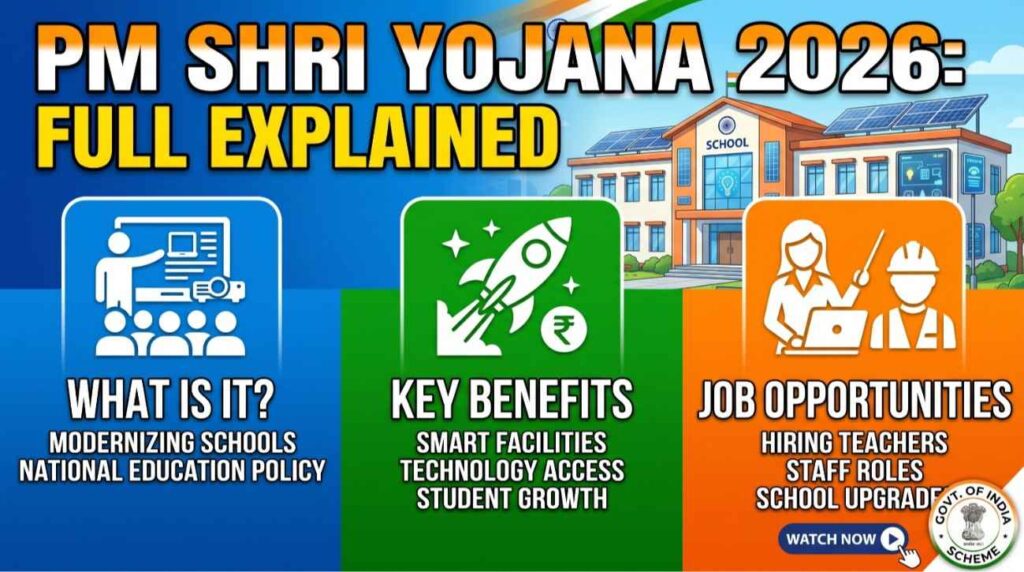
PM SHRI Yojana 2026 — full form PM ScHools for Rising India — is a centrally sponsored school upgrade scheme launched by the Ministry of Education, Government of India on 5 September 2022, on the occasion of Teachers Day. The scheme is directly built on the foundation of the National Education Policy (NEP) 2020 and aims to demonstrate what 21st-century government schooling in India can look like at its very best.
Under PM SHRI, selected existing government schools — run by central government, state governments, local bodies, and Kendriya Vidyalayas or Navodaya Vidyalayas — are chosen for comprehensive upgradation. Each selected school receives funding, infrastructure development, teacher training, digital integration, and academic restructuring to transform it into a PM SHRI Model School.
The key goals driving PM SHRI Yojana in 2026 are:
- Upgrading 14,597 schools across India into fully equipped model institutions
- Implementing NEP 2020 holistic education principles at the grassroots level
- Developing green, sustainable school campuses with eco-friendly infrastructure
- Integrating digital technology — smart boards, computer labs, and online learning tools — into everyday teaching
- Strengthening foundational literacy and numeracy for early childhood learners
- Creating new teaching and non-teaching employment as upgraded schools expand capacity
The scheme is funded on a 60:40 cost-sharing basis between the central government and state governments — and 90:10 for northeastern and hilly states — making it a true partnership between the Centre and every participating state.
Key Features and Benefits
PM SHRI Yojana 2026 delivers benefits at three levels — to students, to teachers, and to the broader education ecosystem of India. Here is a detailed breakdown:
- World-Class School Infrastructure — Each PM SHRI school receives funding for construction and renovation of smart classrooms, science and computer labs, libraries, sports facilities, drinking water systems, clean toilets, and barrier-free access for differently-abled students.
- NEP 2020 Aligned Curriculum — PM SHRI schools implement the new National Curriculum Framework based on NEP 2020 — with a strong focus on critical thinking, experiential learning, art integration, and 21st-century skills rather than rote memorization.
- Digital and Smart Learning Tools — Every PM SHRI school is equipped with interactive smart boards, digital content libraries, computer labs, and high-speed internet connectivity — ensuring students are prepared for a technology-driven future.
- Holistic Child Development — The scheme emphasizes sports, arts, music, yoga, and extracurricular activities as core components of education — not optional additions — aligned with NEP 2020’s vision of holistic development.
- Teacher Training and Capacity Building — Teachers in PM SHRI schools receive regular professional development training, subject-specific workshops, and leadership development programs — making these among the best-supported teaching positions in the country.
- Green and Eco-Friendly Campuses — PM SHRI schools are designed with sustainability in mind — solar panels, rainwater harvesting, waste management systems, and gardens — setting an environmental example for the entire community.
- Foundational Learning Focus — Special programs under the NIPUN Bharat Mission are integrated into PM SHRI schools to ensure every child achieves basic reading and arithmetic proficiency by Class 3.
- Community and Parent Engagement — PM SHRI schools actively involve parents and local communities through school management committees, parent-teacher meetings, and community outreach programs — creating a strong support system around each school.
PM SHRI Yojana 2026 — Job Opportunities
Every school selected under PM SHRI undergoes significant expansion — in capacity, in programs, and in staffing needs. This creates a steady wave of new teaching and non-teaching vacancies across all participating states. Here is a post-wise breakdown of opportunities:
Teaching Posts in PM SHRI Schools
| Post | Classes Covered | Min. Qualification | Salary Range (₹/month) |
|---|---|---|---|
| Primary Teacher (PRT) | Classes 1 to 5 | 12th Pass + D.El.Ed + CTET Paper 1 | ₹35,400 – ₹1,12,400 |
| Trained Graduate Teacher (TGT) | Classes 6 to 10 | Graduate + B.Ed + CTET Paper 2 | ₹44,900 – ₹1,42,400 |
| Post Graduate Teacher (PGT) | Classes 11 to 12 | Postgraduate + B.Ed | ₹47,600 – ₹1,51,100 |
| Special Educator | Classes 1 to 8 | Graduate + B.Ed Special Education | ₹35,400 – ₹1,12,400 |
| Art and Craft Teacher | Classes 1 to 8 | Diploma / Degree in Fine Arts | ₹35,400 – ₹1,12,400 |
| Physical Education Teacher | Classes 6 to 12 | B.P.Ed Degree | ₹44,900 – ₹1,42,400 |
Non-Teaching Posts in PM SHRI Schools
| Post | Min. Qualification | Salary Range (₹/month) |
|---|---|---|
| School Librarian | Graduate + B.Lib.Sc. | ₹35,400 – ₹1,12,400 |
| Lab Assistant (Science) | 12th Pass with Science + ITI | ₹19,900 – ₹63,200 |
| Computer Instructor | Graduate + BCA / B.Sc Computer | ₹25,500 – ₹81,100 |
| Office Assistant / Clerk | 12th Pass + Computer Proficiency | ₹19,900 – ₹63,200 |
| Counselor / Wellness Teacher | Graduate in Psychology or Social Work | ₹35,400 – ₹1,12,400 |
Salary ranges follow the 7th Pay Commission structure. Exact pay depends on the school’s administrative category — central, state, or local body — and the posting state.
Eligibility Criteria and Required Documents
Eligibility Table
| Post | Min. Qualification | Additional Requirement | Age Limit |
|---|---|---|---|
| PRT | 12th Pass (50%) + D.El.Ed / B.El.Ed | CTET Paper 1 mandatory | 18–35 years |
| TGT All Subjects | Graduate (50%) + B.Ed | CTET Paper 2 mandatory | 18–35 years |
| PGT All Subjects | Postgraduate (50%) + B.Ed | CTET Paper 2 preferred | 18–40 years |
| Special Educator | Graduate + B.Ed Special Ed. | RCI registration required | 18–35 years |
| Physical Education | B.P.Ed Degree | — | 18–35 years |
| Librarian | Graduate + B.Lib.Sc or M.Lib.Sc | — | 18–35 years |
| Lab Assistant | 12th Science + ITI Certificate | — | 18–30 years |
| Computer Instructor | Graduate + BCA / B.Sc CS | — | 18–35 years |
Age relaxation — 5 years for SC/ST candidates, 3 years for OBC, 10 years for PwD as per central and state government norms.
Required Documents
- Aadhaar card — mandatory for identity verification and application
- 10th and 12th marksheets with passing certificates
- Graduation and postgraduate degree certificate with all marksheets
- B.Ed or D.El.Ed degree certificate or provisional certificate
- Valid CTET certificate — Paper 1 for PRT, Paper 2 for TGT
- RCI registration certificate for Special Educator posts
- Caste certificate — SC, ST, or OBC issued by competent authority
- PwD certificate from government medical board if applicable
- Experience certificate if required for the specific post
- Recent passport-size photograph — white background, clear face
- Scanned signature on plain white paper in required format
- Bank account details for application fee payment
How to Apply — Step-by-Step Process
Teaching vacancies in PM SHRI schools are filled through the recruitment processes of the respective administering bodies — central government schools through KVS or NVS portals, and state government PM SHRI schools through state education recruitment boards. Follow these eight steps carefully:
- Identify your target PM SHRI school’s administering authority — Check whether the PM SHRI school you want to apply to is administered by KVS, NVS, a state government education board, or a local body. Each has its own recruitment portal and process.
- Visit the correct official recruitment portal — For KVS-administered PM SHRI schools go to kvsangathan.nic.in. For NVS-administered schools go to nvs.ac.in. For state government PM SHRI schools visit your respective state’s school education recruitment board portal.
- Download and read the official recruitment notification — Find the active 2026 recruitment notification for PM SHRI school vacancies. Download the full PDF and read every page — eligibility, vacancy details, exam pattern, and important dates without skipping any section.
- Complete your new user registration on the portal — Click “New Registration” and enter your full name exactly as on Aadhaar, date of birth, active mobile number, and email ID. Save your login credentials in a safe place immediately.
- Fill the online application form with complete accuracy — Log in and complete all sections — personal details, educational qualifications, CTET certificate number, category, teaching experience, and preferred subject or post. Double-check every field before proceeding.
- Upload all required documents correctly — Scan and upload your photograph, signature, educational certificates, CTET scorecard, and caste certificate in the exact format, pixel size, and file size specified in the notification. Incorrectly formatted uploads are rejected without any warning.
- Pay the application fee through online payment — Use UPI, debit card, credit card, or net banking. General/OBC candidates typically pay ₹1,000 to ₹1,500 depending on the administering body. SC/ST candidates pay 50% of the standard fee. PwD candidates are fully exempt.
- Submit your application and download the confirmation page — After clicking “Final Submit,” immediately download your confirmation page and note your application reference number. Keep a printed copy safely until the entire recruitment process — including joining — is completed.
Pro Tip: PM SHRI school recruitment notifications are released separately by each state and central body — not all at once through a single portal. Subscribe to email alerts on the official portals of both KVS and your state education recruitment board so you never miss an active notification for your preferred post.
PM SHRI Yojana vs Other Central School Schemes — Quick Comparison
| Feature | PM SHRI Yojana 2026 | KVS Schools | NVS Schools |
|---|---|---|---|
| Scheme Type | Upgrade existing govt. schools to model schools | Run dedicated central govt. schools | Run residential schools for rural talent |
| Number of Schools | 14,597 schools across India | 1,200+ Kendriya Vidyalayas | 661 Jawahar Navodaya Vidyalayas |
| Launched By | Ministry of Education — Sep 2022 | Est. 1963 — Ministry of Education | Est. 1986 — Ministry of Education |
| NEP 2020 Aligned | Yes — core implementation vehicle | Partially — transitioning to NEP | Partially — transitioning to NEP |
| Residential Facility | No — day schools only | No — day schools with HRA | Yes — fully residential campus |
| Teacher Salary | ₹35,400 – ₹1,51,100/month | ₹35,400 – ₹1,51,100/month | ₹35,400 – ₹1,51,100/month |
| Funding Model | 60:40 Centre-State sharing | 100% Central Government | 100% Central Government |
| Application Portal | State board or KVS/NVS portals | kvsangathan.nic.in | nvs.ac.in |
Details are approximate and based on 2026 official government notifications and scheme guidelines.
Frequently Asked Questions (FAQ)
Q1: What is the full form and main purpose of PM SHRI Yojana 2026? PM SHRI stands for PM ScHools for Rising India. The main purpose of PM SHRI Yojana 2026 is to upgrade 14,597 existing government schools across India into fully modern, technology-enabled, NEP 2020-aligned model institutions. These upgraded schools are designed to serve as exemplary centers of learning in their respective districts — demonstrating what quality government education can look like when given the right infrastructure, trained teachers, digital tools, and community support. Every PM SHRI school aims to deliver holistic, skill-based, and experiential education that prepares students for higher education, vocational paths, and 21st-century careers.
Q2: How are PM SHRI schools selected across India in 2026? PM SHRI schools are selected through a challenge mode process — meaning schools apply to be considered for PM SHRI status rather than being assigned automatically. Schools submit applications through the official portal demonstrating their existing infrastructure, academic performance, community involvement, and readiness for upgradation. A national evaluation committee assesses each application based on defined criteria aligned with NEP 2020 goals. Selected schools then sign a performance-linked agreement committing to specific improvement targets over a defined period. States and union territories that have signed the MOU with the central government are eligible to nominate schools for PM SHRI consideration in 2026.
Q3: Is CTET mandatory for teaching jobs in PM SHRI schools in 2026? Yes — CTET is mandatory for PRT and TGT level teaching posts in PM SHRI schools administered by central government bodies such as KVS and NVS. PRT candidates must hold a valid CTET Paper 1 certificate and TGT candidates must hold CTET Paper 2. For state government-administered PM SHRI schools, the respective state TET (STET) qualification is mandatory in place of or in addition to CTET depending on state policy. For PGT posts covering Classes 11 and 12, CTET requirements vary by administering authority — always check the specific recruitment notification. CTET certificates are now permanently valid as per the latest Government of India order.
Q4: What salary and benefits do teachers in PM SHRI schools receive? Teachers appointed in PM SHRI schools receive salaries as per the 7th Pay Commission pay matrix of the respective administering body — KVS, NVS, or state government. PRT teachers start at approximately ₹35,400 per month basic pay. TGT teachers start at ₹44,900 and PGT teachers at ₹47,600 per month basic pay. Total in-hand salary including Dearness Allowance, HRA, and Transport Allowance typically ranges from ₹48,000 to ₹88,000 per month depending on the post and posting city. Additional benefits include NPS pension coverage, CGHS medical coverage, child education allowance, and annual increment — making the total compensation package highly competitive.
Q5: How many PM SHRI schools will be operational across India by end of 2026? The Government of India has set a target of upgrading 14,597 PM SHRI schools across all states and union territories of India under the scheme. As of 2026, over 6,400 schools have already been formally selected and are at various stages of upgradation — with infrastructure development, teacher training, and digital integration actively underway. The remaining schools are being added in phases as more states sign the MOU and complete the school selection process. Each selected school receives central funding in installments linked to performance milestones. The complete list of selected PM SHRI schools district-wise is available on the official scheme portal at pmshrischools.education.gov.in.
Conclusion
PM SHRI Yojana 2026 is not just an infrastructure upgrade program — it is a fundamental reimagining of what government schooling in India can and should be. For students, it means access to world-class learning environments that were previously available only in elite private schools. For teachers, it means working in well-equipped, professionally supported schools with strong salaries, regular training, and the deep satisfaction of shaping India’s next generation. And for job seekers in the education sector — PM SHRI is creating thousands of new, permanent, well-paid government teaching positions across every state in India right now. Start your preparation today, check your eligibility, gather your documents, and apply through the official recruitment portal of the administering body in your state. Found this guide helpful? Share it with every teacher aspirant you know, drop your questions in the comments below, and visit pmshrischools.education.gov.in for the complete list of PM SHRI schools and all latest recruitment updates.