- Key Takeaways
- Introduction
- What Are Pre-Matric and Post-Matric Scholarships 2026?
- Pre-Matric Scholarship 2026 — Complete Details
- Post-Matric Scholarship 2026 — Complete Details
- Key Features and Benefits
- Eligibility Criteria and Required Documents
- How to Apply — Step-by-Step Process
- Pre-Matric vs Post-Matric Scholarship — Key Differences at a Glance
- Important Deadlines — NSP Scholarship Calendar 2026
- Frequently Asked Questions (FAQ)
- Conclusion
Key Takeaways
- Pre-Matric Scholarship 2026 covers students in Classes 9 and 10 from SC, ST, OBC, Minority and PwD communities.
- Post-Matric Scholarship 2026 covers students from Class 11 through PhD level across all eligible categories.
- Scholarship amounts range from ₹150 per month to ₹1,200 per month plus maintenance allowance depending on category and course level.
- Family annual income must be below ₹1 lakh to ₹2.5 lakh depending on the specific scholarship scheme.
- All applications are submitted free of charge through the official National Scholarship Portal at scholarships.gov.in.
Introduction
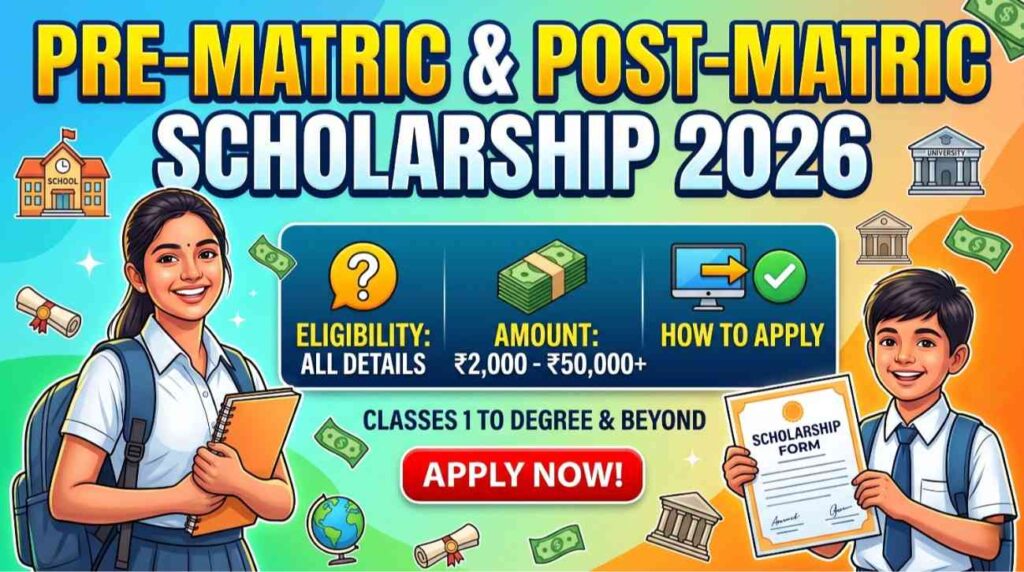
Every year millions of Indian students from SC, ST, OBC, minority, and differently-abled communities face one devastating choice — continue their education and struggle financially or drop out and start earning. Pre-Matric and Post-Matric Scholarship 2026 exists specifically to eliminate that choice. These two flagship scholarship programs — funded by the Government of India and delivered directly to students’ bank accounts — cover everything from Class 9 school students to PhD scholars pursuing research degrees. In 2026 the combined beneficiary base of these two programs exceeds 3 crore students across every state and union territory in India. Whether you are a Class 9 student from an SC family, an OBC girl pursuing a medical degree, or a minority student completing a postgraduate program — this complete guide tells you exactly which scheme covers you, how much money you will receive, what documents you need, and the exact steps to apply online today.
What Are Pre-Matric and Post-Matric Scholarships 2026?
Pre-Matric Scholarship 2026 and Post-Matric Scholarship 2026 are two complementary central government scholarship programs designed to support students from socially and economically disadvantaged communities at two different stages of their education:
Pre-Matric Scholarship — covers students currently studying in Classes 9 and 10 — the final two years of secondary school before the Class 10 board examination. The word “Pre-Matric” refers to the period before the matriculation — the Class 10 board exam — which is why this scholarship supports students in these two critical classes.
Post-Matric Scholarship — covers students who have passed Class 10 and are studying in Class 11, Class 12, undergraduate programs, postgraduate programs, professional courses, or doctoral research — essentially any level of education after matriculation.
Both scholarship types are available across five major student communities:
- SC — Scheduled Caste students — managed by Ministry of Social Justice and Empowerment
- ST — Scheduled Tribe students — managed by Ministry of Tribal Affairs
- OBC — Other Backward Class students — managed by Ministry of Social Justice and Empowerment
- Minority students — Muslim, Christian, Sikh, Buddhist, Jain, Zoroastrian — managed by Ministry of Minority Affairs
- PwD — Persons with Disability students — managed by Ministry of Social Justice and Empowerment
All applications for these scholarships are processed through the National Scholarship Portal at scholarships.gov.in — India’s unified digital platform for all central government scholarship schemes.
Pre-Matric Scholarship 2026 — Complete Details
Pre-Matric Scholarship — Category Wise Eligibility and Amount
| Category | Class | Income Limit | Monthly Amount | Annual Maintenance |
|---|---|---|---|---|
| SC Students | Class 9 and 10 | Below ₹2.5 lakh/year | ₹150 (Day Scholar) · ₹350 (Hosteller) | ₹750 – ₹1,000 extra |
| ST Students | Class 9 and 10 | Below ₹2.5 lakh/year | ₹150 (Day Scholar) · ₹350 (Hosteller) | ₹750 – ₹1,000 extra |
| OBC Students | Class 9 and 10 | Below ₹1 lakh/year | ₹100 (Day Scholar) · ₹300 (Hosteller) | ₹500 – ₹750 extra |
| Minority Students | Class 1 to 10 | Below ₹1 lakh/year | ₹100 – ₹500/month | ₹500 – ₹1,000 extra |
| PwD Students | Class 9 and 10 | Below ₹2.5 lakh/year | ₹350 (Day Scholar) · ₹700 (Hosteller) | ₹1,000 extra |
Pre-Matric Scholarship — Key Eligibility Conditions
- Student must be studying in Class 9 or Class 10 in a recognized government or private school
- Student must belong to SC, ST, OBC, Minority, or PwD community with valid certificate
- Family annual income must be within the specified limit for the respective category
- Student must have scored minimum 50% marks in the previous class examination
- Student must be enrolled full-time — part-time students are not eligible
- Scholarship can be renewed in Class 10 if the student passes Class 9 with satisfactory marks
- Only one scholarship per student is allowed — students cannot hold two Pre-Matric scholarships simultaneously
Post-Matric Scholarship 2026 — Complete Details
Post-Matric Scholarship — SC Students Amount Table
| Course Level | Day Scholar (₹/month) | Hosteller (₹/month) | Reader Allowance | Study Tour |
|---|---|---|---|---|
| Class 11 and 12 | ₹230 | ₹380 | — | — |
| Undergraduate — Non-Professional | ₹300 | ₹570 | — | — |
| Undergraduate — Professional (Engineering/Medical) | ₹530 | ₹820 | ₹240/month (PwD) | ₹1,600/year |
| Postgraduate — Non-Professional | ₹300 | ₹570 | — | — |
| Postgraduate — Professional | ₹530 | ₹820 | ₹240/month (PwD) | ₹1,600/year |
| PhD and Research | ₹550 | ₹820 | ₹240/month | ₹2,000/year |
Post-Matric Scholarship — ST Students Amount Table
| Course Level | Day Scholar (₹/month) | Hosteller (₹/month) |
|---|---|---|
| Class 11 and 12 | ₹230 | ₹380 |
| Undergraduate General | ₹300 | ₹570 |
| Undergraduate Professional | ₹530 | ₹820 |
| Postgraduate General | ₹300 | ₹570 |
| Postgraduate Professional | ₹530 | ₹820 |
| PhD and Research | ₹550 | ₹820 |
Post-Matric Scholarship — OBC Students Amount Table
| Course Level | Day Scholar (₹/month) | Hosteller (₹/month) |
|---|---|---|
| Class 11 and 12 | ₹200 | ₹350 |
| Undergraduate General | ₹250 | ₹500 |
| Undergraduate Professional | ₹480 | ₹750 |
| Postgraduate | ₹250 | ₹500 |
| Professional Courses | ₹480 | ₹750 |
Post-Matric Scholarship — Minority Students Amount Table
| Course Level | Amount (₹/year) |
|---|---|
| Class 11 and 12 | ₹7,000 per year |
| Undergraduate | ₹7,000 per year |
| Postgraduate | ₹10,000 per year |
| Technical and Professional | ₹10,000 per year |
Post-Matric Scholarship — PwD Students Amount Table
| Course Level | Day Scholar (₹/month) | Hosteller (₹/month) |
|---|---|---|
| Class 11 and 12 | ₹500 | ₹800 |
| Undergraduate | ₹700 | ₹1,000 |
| Postgraduate | ₹1,000 | ₹1,500 |
| Professional Courses | ₹1,200 | ₹2,000 |
All scholarship amounts shown above are basic stipend amounts. Additional components including maintenance allowance, reader allowance for blind students, study tour charges, thesis typing charges for PhD scholars, and book allowance are paid separately as per applicable scheme guidelines. Final amounts are confirmed in the official NSP notification every academic year.
Key Features and Benefits
Pre-Matric and Post-Matric Scholarships 2026 deliver a package of benefits that goes well beyond just the monthly stipend amount:
- Direct Bank Transfer — Zero Deductions — Every scholarship amount is transferred directly to the student’s Aadhaar-linked bank account through DBT. No institution can deduct hostel fees or tuition from the scholarship amount — the full amount reaches the student without any deduction.
- Covers Both Day Scholars and Hostellers — Scholarship amounts are structured differently for students living at home (day scholars) and students living in hostels — recognizing that residential students face higher living expenses and need additional financial support.
- Additional Allowances Beyond Basic Stipend — Post-Matric scholarship recipients receive multiple additional components — maintenance allowance, study tour charges, thesis typing charges for research students, reader allowance for blind students, and escort allowance for orthopedically disabled students.
- Tuition Fee Reimbursement — For SC and ST students in professional courses — engineering, medical, MBA, law — the Post-Matric scholarship includes full tuition fee reimbursement in addition to the monthly stipend — making professional education genuinely accessible.
- Annual Renewal System — Both scholarships are renewed every year for students who maintain satisfactory academic performance — providing consistent multi-year support rather than one-time payments.
- Covers Wide Range of Courses — Post-Matric scholarship covers virtually every recognized course — Class 11, Class 12, BA, B.Sc, B.Com, B.Tech, MBBS, MBA, MA, M.Sc, M.Tech, LLB, CA, ICWA, ICS, PhD — ensuring no eligible student is left uncovered because of their course choice.
- No Bond or Repayment — Both Pre-Matric and Post-Matric scholarships are pure grants with zero repayment obligation, no service bond, and no post-scholarship commitment of any kind required from recipients.
- Grievance Resolution on NSP — Students who face payment delays, application rejection errors, or document issues can raise grievances directly through the NSP portal — with a mandatory resolution timeline for nodal officers at district and state level.
Eligibility Criteria and Required Documents
Master Eligibility Table 2026
| Scholarship Type | Category | Study Level | Min. Marks Previous Class | Income Limit |
|---|---|---|---|---|
| Pre-Matric | SC | Class 9 and 10 | 50% in Class 8 | Below ₹2.5 lakh/year |
| Pre-Matric | ST | Class 9 and 10 | 50% in Class 8 | Below ₹2.5 lakh/year |
| Pre-Matric | OBC | Class 9 and 10 | 50% in Class 8 | Below ₹1 lakh/year |
| Pre-Matric | Minority | Class 1 to 10 | 50% in previous class | Below ₹1 lakh/year |
| Pre-Matric | PwD | Class 9 and 10 | 50% in Class 8 | Below ₹2.5 lakh/year |
| Post-Matric | SC | Class 11 to PhD | 50% in Class 10 | Below ₹2.5 lakh/year |
| Post-Matric | ST | Class 11 to PhD | 50% in Class 10 | Below ₹2.5 lakh/year |
| Post-Matric | OBC | Class 11 to PG | 50% in Class 10 | Below ₹1.5 lakh/year |
| Post-Matric | Minority | Class 11 to PG | 50% in Class 10 | Below ₹2 lakh/year |
| Post-Matric | PwD | Class 11 to PG | 50% in Class 10 | Below ₹2.5 lakh/year |
Income limit refers to annual family income from all sources combined. Income certificate must be issued by a competent government authority — tehsildar, revenue officer, or SDM.
Required Documents
- Aadhaar card of student — mandatory for DBT scholarship transfer
- Previous class marksheet showing minimum 50% marks
- Community certificate — SC/ST/OBC caste certificate or Minority community certificate
- Family income certificate issued by tehsildar or competent revenue officer
- Bonafide student certificate from current school or college on official letterhead
- Bank account passbook — account must be in student’s name and Aadhaar-linked
- Hostel certificate from hostel warden — if applying as a hosteller for higher amount
- Recent passport-size photograph — white background, clear face
- Parent or guardian’s Aadhaar card and identity proof
- Disability certificate from government medical board — for PwD category only
- Domicile or state residence certificate — required in some states
How to Apply — Step-by-Step Process
All Pre-Matric and Post-Matric Scholarship 2026 applications are submitted online through the National Scholarship Portal. Follow these eight steps without skipping any:
- Visit the official National Scholarship Portal — Open your browser and go to scholarships.gov.in — the only official government portal for central scholarship applications. Download and read the scheme-specific guidelines before starting your registration to understand all requirements clearly.
- Complete fresh student registration — Click “New Registration” on the homepage. Read all instructions carefully before proceeding. Enter your full name exactly as on Aadhaar, date of birth, mobile number linked to Aadhaar, email ID, bank account number, and IFSC code. Verify with OTP sent to your registered mobile number.
- Log in and select your scholarship scheme — After registration, log into your dashboard with your application ID and password. Browse all active 2026 scholarship schemes and select the one that matches your community category and current study level — Pre-Matric or Post-Matric as applicable.
- Fill your complete student profile and application form — Complete your personal details, parent or guardian information, community category, current institution name and address, course name, previous class marks, family annual income, bank account details, and hosteller or day scholar status. Fill every field accurately — errors cause rejection or payment delays.
- Upload all required documents — Scan and upload your Aadhaar card, caste or community certificate, income certificate, previous marksheet, bonafide certificate, bank passbook, photograph, and hostel certificate if applicable. Each document must meet the file type — JPG or PDF — and maximum file size specifications shown on the portal. Blurry or incomplete uploads are rejected by the system.
- Review entire application before final submission — Before clicking submit, carefully review every field in your application — especially your Aadhaar number, bank account number, IFSC code, and income certificate details. Errors in bank account information cause payment failures that are very difficult to rectify after submission.
- Submit application and note your application ID — Click “Final Submit” after reviewing. Download and save your application confirmation page immediately. Note your unique NSP Application ID — you will need it for tracking, grievances, and institute verification follow-up.
- Follow up with your institution for NSP verification — After submission, your school or college must log into NSP and verify your enrollment and application details online. Visit your school’s administrative office or college scholarship coordinator personally — request them to complete the NSP institute verification before the deadline. Unverified applications are automatically rejected and cannot be revived after the deadline passes.
Pro Tip: The income certificate is the single most rejected document in Pre-Matric and Post-Matric Scholarship applications across India. Ensure your income certificate clearly states the annual income from all sources combined, is issued by a competent government authority — tehsildar, revenue officer, or SDM — bears a current date within the past 6 months, carries the official seal and signature, and matches the income amount declared on your NSP application form. An income certificate issued by a sarpanch or school principal is not accepted — only certificates from revenue department officials are valid.
Pre-Matric vs Post-Matric Scholarship — Key Differences at a Glance
| Feature | Pre-Matric Scholarship 2026 | Post-Matric Scholarship 2026 |
|---|---|---|
| Study Level Covered | Class 9 and 10 only | Class 11 through PhD |
| Applicable After | Passing Class 8 | Passing Class 10 matriculation |
| Income Limit (SC/ST) | Below ₹2.5 lakh/year | Below ₹2.5 lakh/year |
| Income Limit (OBC) | Below ₹1 lakh/year | Below ₹1.5 lakh/year |
| Income Limit (Minority) | Below ₹1 lakh/year | Below ₹2 lakh/year |
| Monthly Amount Range | ₹100 – ₹700/month | ₹230 – ₹2,000/month |
| Tuition Fee Coverage | Not included | Included for professional courses |
| Additional Allowances | Basic maintenance only | Multiple — study tour, thesis, reader |
| Application Portal | scholarships.gov.in | scholarships.gov.in |
| Managed By | Multiple ministries by category | Multiple ministries by category |
Important Deadlines — NSP Scholarship Calendar 2026
| Activity | Typical Timeline |
|---|---|
| NSP Portal Opens for Fresh Registration | July 2026 |
| Application Submission Window Opens | August 2026 |
| Last Date for Student Application | October 2026 |
| Last Date for Institute Verification | November 2026 |
| District and State Level Approval | November – December 2026 |
| First Scholarship Disbursement | December 2026 – January 2027 |
| Renewal Application Window | August – September 2026 |
Exact dates vary by scheme and state. Always check the official NSP portal for scheme-specific and state-specific deadlines. Missing even the institute verification deadline results in full application rejection for that academic year with no appeal option.
Frequently Asked Questions (FAQ)
Q1: What is the difference between Pre-Matric and Post-Matric Scholarship 2026? Pre-Matric Scholarship 2026 is designed for students currently studying in Class 9 and Class 10 — the final two years of secondary school before the Class 10 board examination. It covers day scholars and hostellers from SC, ST, OBC, Minority, and PwD communities with monthly stipends and maintenance allowances. Post-Matric Scholarship 2026 covers students who have already passed Class 10 and are studying in Class 11, Class 12, undergraduate, postgraduate, professional, or doctoral programs. Post-Matric scholarships carry higher amounts, include tuition fee reimbursement for professional courses, and cover a much wider range of additional allowances — making them the more comprehensive financial support package of the two.
Q2: How much scholarship amount will an SC student in Class 11 receive in 2026? An SC student in Class 11 applying under the Post-Matric Scholarship for SC Students 2026 will receive a monthly stipend of ₹230 per month as a day scholar or ₹380 per month as a hosteller. In addition to the monthly stipend, the student receives a maintenance allowance — the exact amount of which is specified in the state-level notification for your state. For SC students pursuing professional undergraduate courses such as engineering, medical, or law at the college level, the monthly amounts increase significantly — day scholars receive ₹530 per month and hostellers receive ₹820 per month — along with additional components like study tour charges and tuition fee reimbursement.
Q3: What is the income limit for OBC students applying for Post-Matric Scholarship 2026? For OBC students applying for Post-Matric Scholarship 2026, the family annual income limit is below ₹1.5 lakh per year from all sources combined. This is lower than the ₹2.5 lakh income limit applicable to SC, ST, and PwD students for the same scholarship type. The income certificate must be issued by a competent government revenue authority — tehsildar, SDM, or revenue officer — and must clearly state the combined annual income from all sources including agriculture, business, salary, and other earnings. OBC students whose family income exceeds ₹1.5 lakh per year are not eligible for the central Post-Matric OBC scholarship — but may be eligible for state government OBC scholarship schemes with different income thresholds.
Q4: Can a student apply for both Pre-Matric and Post-Matric Scholarship in the same year? No — a student cannot hold both Pre-Matric and Post-Matric scholarships simultaneously as they are designed for different study levels. A Class 10 student receives Pre-Matric scholarship. After passing Class 10 and moving to Class 11, the same student becomes eligible for Post-Matric scholarship — and must apply fresh on NSP for the Post-Matric scheme. The NSP system automatically detects if a student is already receiving a scholarship at one level and prevents double registration. Additionally, most scholarship schemes have a one-scholarship-per-student rule within the same ministry — meaning a student cannot receive two different SC scholarships or two different Minority scholarships at the same time.
Q5: What happens if my school or college does not verify my NSP scholarship application before the deadline? If your school or college fails to verify your NSP application before the official institute verification deadline — your application is automatically rejected by the system. This is the single most common reason for scholarship application failure in India. Once the deadline passes, rejected applications cannot be reactivated or appealed for that academic year — the student must wait and reapply in the next academic year. To prevent this — visit your school’s principal or college’s scholarship coordinator personally and immediately after submitting your NSP application. Show them your application reference number and request written confirmation that they will complete the NSP verification before the deadline. Follow up every week until you see “Verified by Institute” status on your NSP dashboard.
Conclusion
Pre-Matric and Post-Matric Scholarship 2026 are the government’s most direct and powerful tools for keeping deserving students from disadvantaged communities in school and college — from Class 9 all the way through PhD. With millions of beneficiaries, direct bank transfers, zero repayment obligations, and coverage across every major community and every level of education — these scholarships represent a genuine commitment to ensuring that financial hardship never becomes the reason a talented Indian student gives up on their education. If you or someone you know is eligible — register on scholarships.gov.in today, select every scheme you qualify for, prepare your documents carefully, and most importantly — follow up with your institution immediately to ensure verification is completed before the deadline. Found this guide helpful? Share it with every student and parent from SC, ST, OBC, Minority, or PwD communities you know, drop your questions in the comments below, and bookmark scholarships.gov.in for all latest 2026 scholarship notifications, deadlines, and disbursement tracking updates.